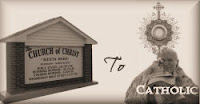
I was recently asked about how my conversion started, and what arguments I found the most persuasive. As much as I've written about my conversion, I realized I'd never really talked in much detail about the very beginning.
It's hard to pinpoint because it really was a combination of many things kind of converging in my head at once. I think I really started to be challenged when I seriously entertained the possibility that this physical, visible Church could be God-lead, and not just man-made as I had always assumed. It dawned on me that there was nothing stopping God from working through human beings...after all, I already believed he had done this in creation of the Bible.
Prior to this the dichotomy always existed in my head, always assumed and never really challenged, that one either follows God or follows man, and the Catholic Church was obviously man-made because it had a hierarchy made up of men. The Catholic Church was led by the pope, a man (which they admitted), and seemed, from my POV, focused on paying respect to men as bishops and priests. I was so stuck on the notion that it was all for power or money (which is utterly laughable these days, lol) that I never even considered the possibility that these priests and bishops could actually be humble servants trying their best to do God's will, quite like the apostles we see in the scriptures.
So, I suppose it really all began with the simple question...what if?
Suddenly I felt compelled to really examine the possibility...What if Christ set up a visible Church on earth, and gave us a visible steward (the pope) not as a replacement of Him, but as a visible authority, led by the Holy Spirit to guide us on earth while He was away? What would that look like? What would I expect this to look like?
I couldn't deny it made sense, all I had to do was look around me at the 1001 interpretations of the Bible various denominations held, all quite sincerely and in good faith. And yet, I still believed God would surely have foreseen this kind of confusion among men and given us something to guard against it...the Catholics proposed a solution, the living authority of the Church.
Basically, it came down to authority for me. I already believed the Bible was God's word...but looking at the history of how the canon of the Bible was decided upon in the first place, I couldn't deny it was the Catholic Church who finally settled the canon. (This was a shock, along with the fact that the "extra books" Catholics had supposedly "added" at some point were, in fact, taken out by Martin Luther at the time of the protestant reformation.) This really kind of shook up my whole world, as I'm sure you can understand the Bible was the center and core of my faith...and now I see it was first canonized by the Catholics, and second tampered with by the Protestants! It really made me realize just how vulnerable a mere book is, and how much it depends upon living people...for canonization, for interpretation, for translation, all kinds of things. And while I believed God could of course work through humans to protect His Written Word, my question was..how did I know which humans to trust? The Bible didn't really tell me that!
So, as I asked myself what would it look like if Christ gave us a living authority in the Church, meant as a companion to the written Word which I already acknowledged as authoritative, I couldn't help but feel that the Catholic Church would be a likely candidate for what that shining city upon a hill might look like.
This, coupled with my reading of the Early Church Fathers, seeing that so much of what the core of Catholicism is about was undeniably present in the Early Church....the Eucharist as the center of their faith, the mass, the sacraments, confession (which seemed so obviousl in Jn 20:23, although I couldn't recall ever reading it before!), their view of Mary as held in great regard...I saw all this and more in the writings of Christians who lived not 100 years after Christ was on the earth.
And the amazing thing was, the Catholic Church, even if it was wrong (which I still at that point assumed) had kept these practices, these teachings just the same for 2,000 years. This was something that really impressed me, as I saw just how fickle mere human beings were, especially in the CoC with a new argument breaking out every couple years over the smallest little detail concerning doctrine or worship.
So...all of this kind of converged at once in my head, and the "what if?" really started to weigh on my heart. I couldn't believe I was even considering the possibility...but each time I did, although I really was looking for proof that the idea was absolutely ridiculous, it seemed from whatever angle I approached, it made so much sense, it fit like a glove. I'd try to snap myself out of it and remind myself of some of the Catholics' most horrid offenses, like their treatment of Mary, and their pompous exaltation of men...but the problem was, I felt a dutiful sense of fairness that compelled me to consider their own explanations of such things. And each time I'd read an explanation of why in their understanding, they're not exalting Mary above Christ or any man on earth above Christ, to my surprise and sometimes terror, their explanation, again, made sense within the context of their worldview.
The more I looked, the more I saw a depth of wisdom that I had never even had a glimpse of in the CoC...and it started with things we agreed on, and led me to consider their points on things I disagreed on. And the more I read and studied and examined, the more pieces of the puzzle that is life started to fall into place in my head. I found answers to questions I'd never even thought to ask brilliantly expounded upon, and little by little, quite despite myself, I started to trust this grand authority on matters of faith and morals. I didn't understand everything, to be sure, and there were some things I still felt quite queasy about...but I had yet to ask a question and not receive a well thought-out and exceedingly wise answer, so I set that queasiness aside and that's when I really started studying to learn, with the intent to become Catholic.
So, I think probably the biggest thing was the question of authority...whether the Bible alone was meant as our only authority, or whether Christ meant for us to have a living, breathing authority guided by the Holy spirit, meant to teach us, to help us interpret scripture rightly, etc. And when I asked "What if...?" and examined the possible answers, it was the Catholic Church that seemed the most logical choice as that living authority, for me, despite the fact that I sincerely hoped to find evidence to the contrary.
I still remained skeptically hesitant, mind you, even when I started seriously considering Catholicism, but each newly answered question and shining bit of supernatural wisdom slowly wore down my skepticism over time, and by my confirmation I couldn't wait to receive what I now believed to be Christ actually present in the Eucharist...and this, Christ in the Eucharist, replaced the Bible as the center and core of my faith as a Catholic, and remains so to this day, thanks be to God!
 You know how when you walk into a familiar place, and the smell of that place hits you, it just brings back all kinds of memories? When I walk into a Target, I can still smell the cleaning solution and my many years working there come flooding back. The smell of a favorite restaurant or food makes me salivate, or even just the thought of that smell! I think it's amazing how tied to memory smell is.