Showing posts with label Books. Show all posts

Tuesday, July 08, 2008

United in Darkness

While on vacation, my father-in-law (*wave*) offered to let us read Come Be My Light, the book which tells us about the hidden suffering of Mother Teresa.

First let me say that any reviewer out there who reads this book and claims that she doubted God her whole life or had a "crisis of faith" or any such thing obviously missed the entire point of her writings. The feeling wasn't there after a certain point in her life, and this caused her much suffering because she longed to feel God's love so much, but the amazing part is that her faith remained and grew despite the lack of feeling, and in fact because of it and even through it. She did not spend her life doubting God, she says herself she never doubted God...her writing is a testament to her great faith. It's really ridiculous that some people try and twist what she said around to say the opposite. On to the book...

It begins with one of the biggest secrets of her life...her vow as a young and fairly new nun, made with the permission of her spiritual director (who obviously had confidence in her ability to keep it). She "made a vow to God, binding under [pain of] mortal sin, to give to God anything that He may ask, 'Not to refuse Him anything.'" It seems so simple and yet what a colossal promise to make. This was her driving force, and in fact people often thought her impatient because once she believed something was a request from God, she wanted to do it as quickly as possible for Him.

It is after making this vow that she heard the "call within a call" to minister to the poorest of the poor. After pushing hard to get permission from the bishop to be able to fulfill this call (but always putting obedience to the bishop first and foremost), she realized her goal and began the Missionaries of Charity. It was then that the darkness began. She worried that it meant she wasn't giving all to God at first, but over the years, through the guidance of a small handful of spiritual directors, it became apparent that Mother Teresa herself continually put God first and foremost, and so the absence of God that she felt was God's Will, a way to unite her suffering with Christ's.

Her longing for God was so great, her desire to please Him so strong, that the darkness, for instance not feeling anything in the presence of the Eucharist or in prayer, was excruciating. And yet, when she came to understand that it was God Himself who willed this, she thanked Him for the darkness and offered to endure it eternally if it would only please Him. And throughout all of this externally she radiated the love of God. Though she did not feel it herself, those around her felt it through her. She was truly living Christ's passion, as God allowed her to share in the desperate plea of Christ, "My God, my God, Why have you forsaken me?" Despite the incurable longing for Christ hidden behind a smile, her faith remained abundantly clear through her actions.

Time and time again she resolved to decrease herself even more so that Christ could increase in her. One resolution was that, "the greater the pain and darker the darkness the sweeter will be my smile at God." She constantly asks for prayers from everyone she writes to, to "Pray for me that I may not refuse Him." She also says "I want to smile even at Jesus & so hide if possible the pain and the darkness of my soul even from Him."

In response to the Offertory verse used for the Mass of the Feast of Sacred Heart (Ps. 68:21) which says, "I looked for one that would grieve together with me, and there was none: and I sought one that would console me, and I found none," she responded herself and encouraged others to respond with, "Be the one." She spoke of the Thirst of Jesus on the cross, and encouraged her sisters to "be the one who will satiate the Thirst. Instead of saying 'I Thirst' say 'be the one,'" echoing Christ's words, "Whatever you did to the least of these, you did to me."

I think what touches me most is her total humility. She always assumed that those suffering around her were suffering more than herself and so she longed to help them. She didn't at all like the spotlight, she begged those who knew about her interior darkness to keep it secret so as not to draw attention to herself. She didn't like the media attention, but only submitted to it out of obedience because her spiritual advisors and bishops told her God was working through her and it was His Will, so when she did have to speak publicly and be in the spotlight, she invariably used it to point ever more to God, never to herself.

I walk away from the book with such a mix of emotions...sadness at her intense interior suffering, wonder at her incessant call to keep smiling through the pain and darkness, and inspiration from her determination to be the Light of Christ for all, and most especially for the "unwanted and unloved" of the world. Above all, though, I come away so deeply humbled by Mother Teresa's intense love of God, her desire to do all and be all for Him alone. I believe the following passage from the book sums it up perfectly:

"Her painful darkness mysteriously united her so intimately with her crucified Spouse, that He became the sole 'object of her thoughts and affections, the subject of her conversations, the end of her actions and the model of her life.' Her total surrender to His will and her determination not to refuse Him anything allowed Him to manifest through her His love for each individual. It was the light and love of Jesus Himself that radiated from her - in the midst of her own darkness - and that had such an impact on others."

Thursday, March 27, 2008

"The Devil is No Fool"

I'm just beginning to read Thomas Merton's The Seven Storey Mountain, and I came upon a passage that had me enthusiastically nodding my head in agreement. Merton is describing his grandparents and their religious views. He explains that he coudn't really tell you which brand of Protestant they were because, it seemed that as far as they were concerned, the various Christian denominations were all pretty much the same. Except, of course, for the Catholics...

"But as for the Catholics - it seemed, in Pop's mind, that there was a certain sinister note of malice connected with the profession of anything like the Catholic faith. The Catholic Church was the only one against which I ever heard him speak with any definite bitterness or animosity...

This was one of the few things I got from Pop that really took root in my mind, and became part of my mental attitude: this hatred and suspicion of Catholics. There was nothing overt about it. It was simply the deep, almost subconscious aversion from the vague and evil thing, which I called Catholicism, which lived back in the dark corners of my mentality with other spooks, like death and so on. I did not know precisely what the word meant. It only conveyed a kind of cold and unpleasant feeling."

I think that any of us who grew up surrounded by anti-Catholicism know exactly what he is talking about. It's not an overt hatred, at least most of the time...but it's a seething feeling of, something akin to disgust. You simply know within your very being that it is so vile and repulsive, and so obviously sinister, that there's no need to even waste one's time considering its claims!

And therein lies the genius of the devil's handiwork.

Merton goes on to explain,

"The devil is no fool. He can get people feeling about heaven the way they ought to feel about hell. He can make them fear the means of grace the way they do not fear sin. And he does so, not by light but by obscurity, not by realities but by shadows, not by clarity and substance but by dreams and the creatures of psychosis. And men are so poor in intellect that a few cold chills down their spine will be enough to keep them from ever finding out the truth about anything."

I thank God that He gave me the grace to move past the cold chills and actually consider the claims of Catholicism, even while knowing all the while I was going to find them completely false. I've never been happier to have been proven so wrong! And not because Catholicism is "easier" or lets me get away with more or has more entertaining worship, all things of which I've been accused. It's simply because I sincerely believe it to be true, and all I ever wanted was to find truth.

Deo Gratias.

Wednesday, August 22, 2007

Sew What! Skirts

So I'm pretty much a beginning seamstress. I can do basic, basic stuff like pillows, curtains, aprons, etc. I also must admit that I HATE using patterns, I'd much rather make something up myself or copy something I have. So I was ecstatic when my sister (who is a mathematician, and loves using patterns, lol) pointed me in the direction of a book called Sew What! Skirts, which is basically a book that encourages and helps you to make your own skirts without patterns. I HAD to have it, so I went searching for it and ended up going to 2 different bookstores in order to find it last weekend, lol. But I was so glad I did!

There are so many great ideas in this book, and it's easy enough that even a beginner like me can do it. So, I pulled out a circle skirt panel that my sis had bought me when I got a sewing machine from hubby on my birthday a couple years ago. (Don't worry, I asked for it specifically, lol). Unfortunately, the circle skirt panel was a bit too small, so I decided to cut the waist a bit wider, but of course this had the result of shortening the skirt. I like to be comfy in my skirts and not have to worry that I'm flashing people, so after reading Sew What! Skirts, I took the idea of a layered skirt and decided to just add a longer layer underneath. It was a tad more difficult than the book because I had to make some changes here and there (because the book uses two A-line skirts, not a circle skirt and an A-line skirt). The result is below:


It's not the greatest skirt in the world, but it's my first! I'm proud. :-) I hope there are many more to come! And for anyone who needs inspiration or encouragement to do your own thing with the sewing machine, especially when it comes to skirts, I highly recommend this book!

Sunday, July 29, 2007

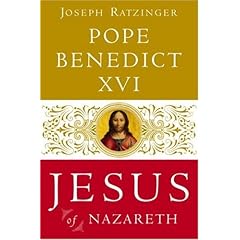
Jesus of Nazareth

I've just finished reading Pope Benedict's Jesus of Nazareth. I really enjoyed it. If I had to describe it in one word, I'd say it's peaceful. Pope Benedict gently guides the reader to familiar scenes and sayings of Christ, and then expounds upon them quite simply. There are no big theologically fancy words or complicated explanations. And yet, I found myself again and again thinking, "Wow...why had I never seen that before?"

For instance, in one part discussing the Torah, Pope Benedict (with help from Rabbi Neusner) explains first the importance of the Sabbath to the Jews. Then he shows how, in light of this, how shocking Jesus' words (words that I've heard repeated and repeated myself many times without considering this aspect of them) would have been.

"[Neusner] then adds: 'Not working on the Sabbath stands for more than nitpicking ritual. It is a way of imitating God.' The Sabbath is therefore not just a negative matter of not engaging in outward activities, but a positive matter of 'resting,'..."

"For Neusner, the key word rest, understood as an integral element of the Sabbath, is the connecting link to Jesus' exclamation immediately prior to the story of the disciplies plucking the ears of wheat in Matthew's Gospel...[it] reads as follows: 'Come to me, all who labor and are heavy laden, and I will give you rest. Take my yoke upon you, and learn from me; for I am gentle and lowly in heart, and you will find rest for your souls. For my yoke is easy and my burden is light" (Mt 11:28-30). This is usually interpreted in terms of the idea of the liberal Jesus, that is, moralistically. Jesus' liberal understanding of the Law makes for a less burdensome life than "Jewish legalism." This interpretation is not very convincing in practice,though, for following Christ is not comfortable - and Jesus never said it would be, either.

"What follows from this? Neusner shows us that we are dealing not with some kind of moralism, but with a highly theological text, or, to put it more precisely, a Christological one. Because it features the motif of rest, and the connected motifs of labor and burden, it belongs thematically with the question of the Sabbath. The rest that is intended here has to do with Jesus...Neusner sums up the overall content as follows: "My yoke is easy, I give you rest, the son of man is lord of the Sabbath indeed, because the son of man is now Isreal's Sabbath: how we act like God."

"...'No wonder, then, that the son of man is lord of the Sabbath! The reason is not that he interprets the Sabbath restrictions in a liberal manner...Jesus was not just another reforming rabbi, out to make life "easier" for people...No, the issue is not that the burden is light...Jesus' claim to authority is at issue...Christ now stands on the mountain, he now takes the place of the Torah.'..."

"The issue that is really at the heart of the debate is thus finally laid bare. Jesus understands himself as the Torah - as the word of God in person."

After many more "aha!" moments and connections similar to this one, in the end I'm left with a sudden desire to go back and read the Old Testament from start to finish - partly because we never much focused on the Old Testament growing up in the CoC, and also partly because with my newer Catholic outlook, and with bits and pieces of the Old Testament that were highlighted in Jesus of Nazareth, I feel like there is so much that will jump out at me now that I had glossed over so many times before.

Overall, a great book, and a great resource for unlocking the depths of Christ's words in scripture.

Sunday, July 22, 2007

Harry Potter and the Deathly Hallows

I'm done reading it!!!

*Happy, content sigh*

Friday, June 22, 2007

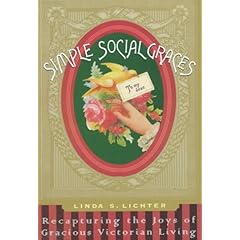
Simple Social Graces

I've mentioned before that I'm very much a girly-girl, I love dressing up, and most of all I enjoy being feminine. I've always been very interested in gender roles, and in how our society has changed its views about gender roles (for better or for worse - probably some of both!) For my last assignment in my Senior Seminar class at college, I chose to write about the drastic change in fashion from the late Victorians to the Flappers of the 1920s, and what this outward change signified in terms of inner thoughts about gender roles. It seemed to me that while so-called feminists were claiming to want to fight for women and "free" them from the shackles of patriarchy and oppression, they went about it quite wrong. What they did was try to usurp men's roles, and try to turn themselves into men, and by doing so they actually diminished the value of women and femininity. I focused on fashion as the outward expression of this desire to become more man-like.

Up until then, in all ages, female fashion was about emphasizing the uniquely female shape. In some ages it was popular to look nearly pregnant (with empire waists and such), in some ages it was popular to emphasize the hips (think 1700s full skirts with hoops protruding over the hips), in some ages it was popular to emphasize the derriere, with a bustle in the back. But it wasn't until the 20s that women started trying to de-emphasize their womanly figure. Hair was chopped off, breasts were bound tightly to appear flat-chested, dresses were shapeless, and big baggy suit-type dresses became popular. Behavior also changed, woman took up publicly drinking (and more importantly getting drunk) and smoking profusely to keep up with the men, and they also started trying to keep up with them in their number of casual sexual encounters. These issues and many more were the topic of my paper, Forsaking Femininity, and it remains a great interest to me. My curiosity was piqued, then, when someone from the ex-CoC board recommended a book about the Victorians and what they had that we have lost, called Simple Social Graces.

Much of this book clarifies some myths that we have about the Victorians that arose largely because of disdain for them, and out of attempts to promote modern ideas about sexuality and more. The author, Linda S. Lichter, explains well how the Victorians were not prudes who all thought sex was dirty and at best a duty, in fact they had such a high regard for it that they kept it where it should be - between husband and wife. I often wondered, as I studied Victorian literature, just how we got the concept that these people were stiff, cold, unfeeling prudes, because the literature I read swelled with beautiful descriptions of transcendental love, and of deep, yet controlled, passion. The "subtle sensuality" is more romantic than any smut widely seen on TV soap operas today. And isn't it the Victorian elaborate cards and meaningful flowers we think of when Valentine's Day comes around? They were certainly not lacking in love just because they thought it proper to control lust.

I've always seen a deep respect and consideration in the detailed traditions of the Victorians, especially in their focus on proper etiquette and treatment of people. Those who cry that such customs are "empty" and "superficial" tend to remind me of those who say the same about Catholic practices. But having come to believe in the truth of the phrase, lex orandi, lex credendi, I tend to think a proper translation applied to the Victorians would be, how we behave is how we believe. When you learn to treat everyone with consideration and respect because of customs and etiquette, it tends to spill over into your actual thought process.

Lichter also explains how much of the etiquette protected women, and was actually very pro-woman, and allowed the woman to often be in charge of the situation. For instance, a man was expected to properly tip his hat or bow when passing a woman he knew on the street, and she was expected to show appreciation, but the man was not to "take advantage" of her polite return gesture by pushing more acquaintance, unless she invited it. It was her choice. Such universal rules helped to level the playing field, to allow everyone to be respectful and be respected.

Another topic Lichter talks about is the home, and how it has changed from the Victorian notion of the heart of the family, and a sanctuary to a mere building where people cohabitate. I couldn't help being reminded of the Catholic notion of the Domestic Church as she explained the Victorian views of home, a place where the smallest chore becomes an act of love and sacrifice for your family.

One thing I would have liked to see more of, which wasn't mentioned a whole lot was the effects of artificial birth control on our attitudes towards sex. There are some beautiful chapters about marriage and sex and how it has been cheapened by gross publicity and blatant vulgarity, which I think would have been made even better with a look at how significant a role artificial birth control played in that. She does mention in passing the Victorian view that contraceptives carried with them the danger of making women into a mere play-thing, and that men who practiced periodic abstinence for the sake of their wives' health epitomized self-sacrifice and proved their love (NFP anyone?), but that's about as far as it goes. The wisdom of the Church's teaching on contraception was a constant glaring factor for me as I read these chapters, though.

Simple Social Graces presents a stunning juxtaposition of just how far we have come in destroying respect for our fellow human beings, and especially women, even while modern feminists attempted to do the opposite. The small, simple things that were done revealed an underlying sense of self-sacrifice, and the focus was on humility rather than pride as it often is today.

There were a few things that I disagreed with in the book. I think it's possible that the often-perfect picture painted of the Victorians may be just a little too perfect. I also question the several unsubstantiated references to America being, hands down, the best and most forward-thinking country of the age. Prohibition is often mentioned in an apparently favorable light, which, in my mind, blames an object rather than calling on the necessary self-control touted throughout the rest of the book. I also think many of the character traits that were described as Victorian were not exclusively or originally Victorian, though they may have been the last group to embody them as a whole.

But on the whole, I thoroughly enjoyed Simple Social Graces. I came away with the overall sense that because people found high ideals to be hard to attain, they ended up lowering the ideals to the lowest common denominator. Lichter makes no secret about the fact that in the Victorian age (and before) women were looked to as the keepers of societal virtue, they set the standard and men were expected to meet it. When women began to lower their expectations, all of society suffered the consequences. Certainly in our age this idea sounds extremely sexist, but whether it's politically correct or not, I do believe it's true.

Monday, May 14, 2007

Book Meme!

I've been tagged by Peter for a meme about books! This is a tough one!

Three works of non-fiction everyone should read:

Hmmm...so many wonderful books to choose from!

1. Mere Christianity - C.S. Lewis
Having grown up in a church where any books about Christianity other than the Bible were essentially verboten, this book was an amazing read for me. It helped me to appreciate and understand the Christian faith in a way I never had before.

2. The Science Before Science - Anthony Rizzi
Anyone who is even remotely interested in science, philosophy, or theology should absolutely read this book. It explains the importance and necessity of "right thinking," and the dangers we will inevitably fall into if we don't practice "right thinking." I made a short review of it here.

3. The Catechism of the Catholic Church
Ok so this may be kind of an obvious pick, but I think everyone should sit down and read through it cover to cover at least once. It really is a wealth of information, and I think that we're so used to it being there that it is easy to forget how fortunate we are to have this wonderful compilation of Church teaching filled with scriptural and historical references. Again, coming from a background where we were tied to "the Bible alone," it is a wonderful tool to have as a Catholic!

Three works of fiction everyone should read:

1. Pride and Prejudice - Jane Austen
Ok...if I could, I would just say every Jane Austen novel is a must-read, lol, but I'll choose this one as it's one of the most popular. Her wonderful novels prove to our over-sexed culture that gratuitous sex and detailed descriptions of intimate moments (basically porn in written form) are absolutely unnecessary to have a gripping love story. Mainly, they remind us that love is so much more than sex.

2. Frankenstein - Mary Shelley
This is a beautiful and heartbreaking and penetrating masterpiece that has been mostly overshadowed by the horror film versions of the tale. The real story is about so much more than a "scary monster" (whose name is NOT Frankenstein, btw, the man who created him is Frankenstein.) Definitely a must-read.

3. Brave New World - Aldous Huxley
For obvious reasons, I think this book points to so many of the dangers of our current society.

Three authors everyone should read:

So I already cheated and said Jane Austen, lol...but I'm going to add three more!

G.K. Chesterton
The man was a genius. His writing is simply wisdom and wit rolled into one!

C.S. Lewis
Yeah...pretty much ditto the above!

William Shakespeare
For pretty obvious reasons! He didn't stand the test of time on accident!

Three books no one should read:

Hehe...well, even when I don't like books, I often read them so that I'm aware of what's in them, or why people do read them. But if there were some books I think either do more harm than good or aren't worth much, I'd say...

1. The DaVinci Code - Dan Brown
I don't have to explain this one, do I?

2. Mrs. Dalloway - Virginia Woolf
I admit it, I simply don't like Woolf in general. Certainly it's important to read her work if you're in a literary field to know what it's about, but I just really don't think she has much to offer, contrary to much of the hype that surrounds her. Mrs. Dalloway was one of the worst, IMO.

3. The Left Behind series
I have to steal this one from Peter, because I couldn't agree more!

Phew...that was really hard!!!

I would LOVE to hear what Jennifer's answers would be, and also Kasia's, if y'all are up to it!

Monday, February 26, 2007

Book Review: The Introvert Advantage

I recently finished reading The Introvert Advantage: How to Thrive in an Extrovert World, and I really enjoyed it. I learned a lot about myself, and was able to connect some of the quirks I have that I thought were just random to being very much an introvert! I hate calling people and talking to people on the phone, I much prefer writing to talking, I really hate to be in a very crowded place because it feels like a sensory overload...all of these things are connected to being an introvert. It also helped me to recognize that many of the things that are highly praised in our society are simply traits of extroverts, and there's nothing wrong with me because I don't have those traits. Nothing in the book was really life altering, but it was helpful in pinpointing why I am the way I am about many things, and understanding myself better is always a good thing! I very much recommend it to anyone who is introverted, and anyone who has to deal with introverts on a regular basis. It can help introverts and extroverts understand each other better, and be able to better communicate. It's also a very quick and easy read.

If you're interested, you can get it here.

Monday, November 27, 2006

By What Authority? An Evangelical Discovers Catholic Tradition

After finishing The Science Before Science and then enjoying Jane Austen's Mansfield Park, I was finally able to read this book by Mark Shea, which I have been looking forward to. What I loved about it was the logical progression of thought flowing from the overall and primary question which is often thoughtlessly assumed in the affirmative by many protestants, is scripture sufficient? With this one question, the reader is taken down many avenues of necessarily related sub-questions. Where did we get the Bible from, anyway? Could the Biblical canon itself be from Tradition? Can the scriptures themselves tell us which books belong in the Bible? (Is there a self-attesting canon?) Is all tradition necessarily the tradition of men? Are there examples of tradition used in the bible? Do evangelicals use tradition? Did the Church come from the Bible, or did the Bible come from the Church? Does extra-biblical necessarily mean anti-biblical? And finally, can one accept the authority of that Tradition with regard to the canon while rejecting it with regard to everything else? These questions are answered logically and concisely in this easy to read book (I read it in one day, nearly in one sitting.) I would love to have read this during my conversion, as it tackles all the necessary questions in one easily accessible place, I certainly recommend it. Buy it directly from Mark Shea, and you can even get an autographed copy like I did!

Monday, November 20, 2006

The Science Before Science: A Guide to Thinking in the 21st Century

I have finally finished reading this amazing book. I initially bought it for my husband, because he asked for it. After he read it, he said I needed to read it, and even though I wasn't very interested in it, I took his advice and I did. Now, I'm not much of a science person, I'm much more interested in the arts, which is why I wasn't attracted to reading it initially. But don't let the title of this book fool you...it is about philosophy, and how to use it and apply it in our modern age. Anthony Rizzi describes the problems of much modern thought, which refuses to put "first things first," that is, much of modern thought puts the empiriological as the final goal, and ignores the ontological in the process. He reminds us that, "In all of this, we must remember that being is primary. Knowledge is about reality, not about knowledge." Without proper philosophy to connect the findings of empiriological science back to reality, we end up making absurd conclusions. One such example Rizzi gives is "the nothingness of atoms."

"...if we reduce everything to the arrangement of inert atoms and say atoms are mostly empty space, then we must conclude that we are mostly nothing. As we saw in Chapter 2, there are severe problems with this line of argument. The most manifest problem with the argument is that it implicitly assumes that we know atoms before we know ourselves. This is clearly not true. As we've emphasized, in trying to understand things, we must start with what is more known and proceed to what is less known. However, it is an occupational hazard of physicists, chemists, and scientists and engineers of all types to think of atoms as known first, for in their work, they often think in terms of atoms and not at all about those things that allow them to access and deduce the existence of atoms. These things include the scientists themselves, many other macroscopic things, as well as many significant ideas passed on to them by others.

We see many examples of scientists and philosophers who claim we cannot know that we exist, who claim we cannot trust our senses...and yet, they are happy to accept scientific studies of the physical world, which were done using those very senses they claim we can't trust. In the above example, we see how absurd it is to say that because atoms are composed of mostly nothing, we, therefore, must be mostly nothing...but this conclusion is a very plausible one to make when one doesn't take into consideration the ontological. Rizzi does an excellent job of pointing out such logical fallacies among modern thought, especially when talking about moral relativism, ethics within science, etc.

This is not exactly an easy read, it took me several months to get through it because it is so incredibly dense, I often had to take breaks just to grasp an idea before reading on. However, I highly recommend this book to anyone who is interested in science, in philosophy, in religion, or to anyone who is interested in human thought and learning. This book helps to make clear the purpose of all sciences, to find truth, to conform our minds with reality. To do this, we must first believe that there is a reality that exists, and this is not something that can be tested in a lab, it belongs in the realm of philosophy. An interesting point made in the book is that we all use philosophy, whether we know it or not, but when we do it without proper formation, it's easy to come to mistaken conclusions...even highly educated scientists can go astray because they are lacking proper knowledge of the science that must come before science, philosophy.

Now go out and buy this book!