The past week or so, I've been engaged in a discussion with some fellow ex-ers who ended up losing faith in God. I have to admit that I have a hard time understanding what it's like not to have faith in God, because for some reason, despite my turbulent conversion, that never happened to me. That was the one thing that I clung to when I was confused and scared...my faith in God. It honestly never crossed my mind to doubt His existence. And so, sometimes it's hard for me to discuss with those who have lost faith, because I want to understand them and to be able to communicate with them effectively, but I think there are obstacles to effective communication on both sides.
On my side, it's because, as I mentioned, I can't really grasp what it's like not to believe in God, and I have a hard time relating to their disbelief, which in turn makes it hard for me to explain my own belief in a way they can understand or relate to. On their side, depending on who I'm discussing with, the fact that I never seriously doubted God's existence may cause them to consider anything I say to be tainted with ignorance or naïveté. (I have to say that I am very fortunate to know some very respectful atheists and agnostics who, even if they might think this about me, refrain from using it as an excuse or an attack, and at least seem to thoughtfully consider my remarks.) Obviously, I can't do anything about the latter obstacle, but I can at least try to understand where they are coming from a bit better. So, I decided to read what some former atheists have to say on the matter!
This led me to a couple blogs, namely
Et-tu, Jen? and
Chez Joel. After spending way too much time devouring the contents of blog posts related to atheism and God's existence and proving His existence (or not), I think I finally started to discover better ways to describe the differences between evidence and proof, what it is to have faith, to believe, and why such things are even necessary when discussing with my atheist friends. (At least, things are a little less muddled in my own head now, even if I haven't necessarily helped them!)
Evidence vs. ProofI was first trying to find a way to explain the difference between evidence and proof. I hear a lot about wanting "proof" of something, but when I say that there will never be proof, I often get responses like, "Well then why shouldn't I believe that fairies are what make the world go round?" or the like. But when I say there won't be proof, I'm not saying there won't be evidence. It's just that, because of the nature (or "super" nature) of God, we can't always demand natural evidence, or scientific evidence, we need to be open to considering supernatural or anecdotal evidence. If someone rules out this kind of evidence to begin with, they're closing the case before giving it a chance. One of the blog posts that helped me on this point was from Jennifer's blog on
proof.
Atheists often accuse the religious of having different (specifically subpar) standards for evidence when it comes to belief in God. It seems to me, though, that it is the atheists who hold religion and the existence of God to an impossibly high standard, compared to many other things in everyday life, and then complain (or rejoice, depending) when the evidence fails to meet their standards. And yet these standards are not used on other equally unprovable things in life, such as love. Just as we can't prove scientifically the existence of love, we can't prove scientifically the existence of God. Yet because of evidence I have seen in my life, I believe both exist, and I simply don't find this unreasonable or irrational.
BeliefDuring the course of our discussion, the proposition was made that belief is a choice. Of course, again, the agnostics/atheists of the group say, "Well I'm sorry, but I can't choose to believe in God anymore than I can choose to believe that fairies make the world go round." It seemed to me that they often equate belief or faith with feelings...and this got me thinking about love.
Just as atheists say "I can't make myself believe," many people today say, "I can't make myself love." But what they mean by this is they can't conjure up fuzzy warm feelings. But I believe that real love is a choice...if it weren't, there's no way we could promise to love our spouse for the rest of our lives in our wedding vows. (In fact, I propose that this widespread understanding of love as merely an uncontrollable feeling is partly responsible for the current divorce rate.)
Then I started to wonder, what is belief anyway? If it's not just a feeling, what is it? I found a wonderful answer in a post called
How to Find God in Three Arduous Steps on Chez Joel. He said:
To believe is not to change your mind, or your feelings. It's no good to trick yourself into thinking differently. To believe is simply to act on the assumption that something is true. This!! THIS is what I had been looking for!
The quote from St. Augustine immediately jumped to mind,
"Seek not to understand that you may believe, but believe that you may understand."I know the atheist doesn't like to hear this, and often sees it as a cop out, or as a form of brainwashing, or something along those lines. But if we look at this quote as it applies to love, I think it holds true there as well. If we tweak the quote a bit, and change just one word, we can say, "Seek not to understand that you may love, but love that you may understand."
Do we expect people who have never experienced love to understand it? I mean, it often defies explanation...how can people be self sacrificing and self giving? Why would they do such things, what are they getting out of it? It doesn't really make sense, no one can study love enough to understand it, you have to believe in love, to act on the assumption that it is true, to experience it, before you really understand it. But I don't see people demanding "proof" that love exists before acting as if it does the way they demand proof that God exists, and yet it's not considered unreasonable to make that leap when it comes to love, presumably because most of us experience it from a very early age.
Miracles Another commonly mentioned argument is the
"God, I would believe in you if..." argument. (Once again, Jen's blog was extremely helpful!)There are some very good points made about how even a miracle wouldn't be proof enough, because doubts arise, and eventually we would just want more proof. Certainly God could hand deliver miracles on demand if He wanted, so the fact that He doesn't should push us to consider the possibility that there must be a reason. What does God get out of wanting us to make a leap of faith? What do we get out of having to make that leap of faith? Perhaps taking our example of love, once again, can help us understand.
So many people say, "I would only believe if I could just have one miracle," but what if we asked a potential spouse before we agreed to marriage, "I will believe your love for me exists, and act as if it's true, only if you prove it to me first." This would be virtually impossible, there would be no way to definitively prove such a thing. Part of the beauty of marriage vows is the mutual vulnerability, because this turns into a strength as trust is built and love grows, but the vulnerability must come first. As scary as it is, it is this vulnerability, this surrender that God wants to be able to help us grow...this humility, this is the fertile soil needed to be able to plant that seed of faith. It's only when we recognize our inability to do it ourselves, when we acknowledge the intellect alone isn't enough, it's only when we submit, when we ask God for the faith we need to believe that we can even begin to understand. We simply can't do it on our own, and if we expect or demand to understand before we believe, we'll only end up disappointed.


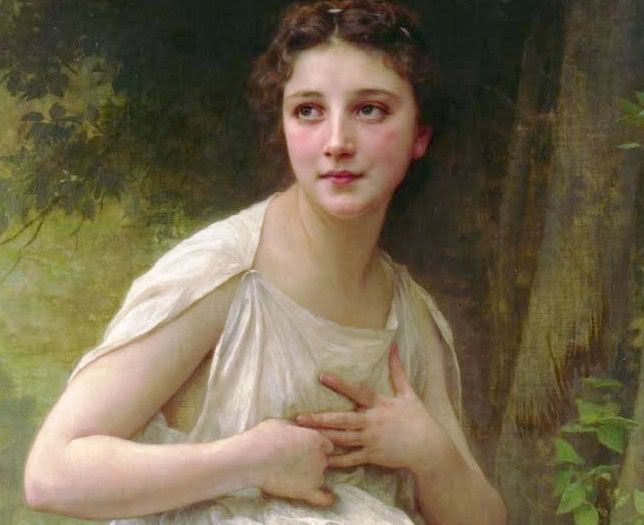 When I was a little girl, I always used to love dressing up in pretty dresses with lots of fabric and flowing skirts. I used to see pictures of times past, when women wore flowing dresses, and wish we could wear them today! My sisters used to joke that I was born in the wrong century. Even today, my tastes tend to lean toward the traditional, toward the classic. I used to wonder why I was so drawn to beautiful things...perhaps I was being too superficial? But I think there's more to it. I can't adequately express the difference I feel when listening to a beautiful piece of music written in the 1600s, and listening to a popular modern tune. Nor can I express the difference I feel when looking at a piece of modern art, and feasting on a classical masterpiece. It just seems there is something more there, in those pieces of visual, musical, and literary art created in times past...it seems deeper, more complex, more beautiful, and, I think most importantly, more true to life, more real. And so I think my attraction to beauty, is really at its deepest level an attraction to truth. It's also partly to blame for my conversion, lol. I once read this article,