Showing posts with label Mary. Show all posts

Monday, August 08, 2011

A Reader Asks - Part 1: Difficulties

Conversion of St. Paul - Murillo

I always find hearing about other people's faith journeys extremely fascinating. I love hearing about the similarities in thought processes, and also noting the differences. What one person found difficult to understand or accept along the way, another person may not have had a problem with at all. But, more often than not, especially when people are coming from similar backgrounds, there are striking similarities. As such, it can be helpful for those potential converts still in the midst of muddling through Catholic beliefs, trying to make heads and tails of so much new information, to know what it is others struggled with, what helped them and gave clarity along the way, and what they had to just take on faith.

I was recently asked just this by a reader of my blog and forum with whom I've enjoyed a bit of correspondence, and thought it would be a great chance to share it on my blog as well. :-) I'll cover each question in a different post, starting with the first.

The reader writes:
I was wondering what in particular you found the hardest to accept about the catholic faith during that long process
My answer to this probably stems from my "thinking" style personality, because as far as Church teachings went, all the arguments I read were so convincing to me that I simply can't recall being completely unconvinced on any one teaching or struggling to accept it. Once I had been convinced of the huge foundational matter of Magisterial authority, once I accepted that God didn't just write down rules for us to follow but actually gave us a living authority to guide and teach us, accepting what that authority taught almost came with a sense of relief. I didn't have to figure everything out on my own, Christ instituted and left us a guide, protected by the Holy Spirit! Hooray! Even more than that, what this authority taught sounded logical and was clearly steeped in wisdom, and further it opened up scripture to me in ways I'd never dreamt possible. But, that didn't mean my feelings kept up with my head!

For me the hardest part was grappling with residual feelings and gut reactions which I'd had all my life. For instance, one minor belief in the grand scheme of things but one which sticks in my mind as being particularly difficult was the matter of drinking alcohol. I'd been taught my whole life that it was poison, inherently and intrinsically evil. Daily evidence on the news of drunk drivers killing innocent people, drunk husbands beating wives, and college kids dying of alcohol poisoning at parties made it easy to accept that alcohol was indeed an evil, with no redeeming qualities whatsoever. I can honestly say I was never tempted by friends or circumstance to drink, because it just wasn't a part of my life and from where I stood it was only ever associated with negative outcomes.

Because of this, during the course of my conversion, while I did find the historical, biblical, and theological arguments in favor of alcohol to be logical and convincing, I still just had a mental hangup with it. I mean, obviously I knew that accepting that alcohol wasn't intrinsically evil didn't mean I had to start drinking myself, but it made my stomach churn to even think of having a husband who drank! I just didn't want to be anywhere near the stuff!

What finally helped me move past this knee-jerk reaction was realizing that alcohol ≠ drunkenness.

I was able to see responsible drinking modeled, especially in my not-yet-husband's French family. I could see that for them, appreciating a good wine was just a part of being thankful for God's many gifts, the way they were for the delicious food on the table as well. To this day, I can't say that I've ever seen my husband drunk, and while I generally don't drink much myself (unless something is sugary sweet, I just can't abide the taste, lol), I no longer have those knee jerk reactions. As with anything, moderation is key, and while scripture does condemn drunkenness, and while I still believe that abusing alcohol can and does often have tragic consequences, I have no doubt that alcohol is not the intrinsic evil I once thought it was.

Another quick example of my feelings not keeping up with my head is on the matter of Marian devotion. If you haven't read it, Mark Shea does an EXCELLENT (and often quite humorous) job describing the deep seated gut reactions we converts have against Marian devotions in the third book of his trilogy, Mary, Mother of the Son. I could identify with so much of what he said, it was spot on. While I'd accepted the teachings on Mary, while I was amazed at the beauty of these teachings and how every one of them ultimately pointed back to Christ, seeing the outrageous, too-colorful, too-flowery devotions of Catholics (and especially Catholics from other cultures) just made me want to get up and run away. After being raised in an environment where even a plain cross on the wall was viewed as unacceptable to God for graven image reasons, seeing such blatant and visually overwhelming love-bombs for Mary was a scary thing!

Some of getting over this visceral reaction was just getting used to the aesthetics around me, but some of it was also learning not to judge others' hearts or intentions. I would remind myself that it was not my place to judge whether this person was honoring Mary above God, and even if I wanted to I couldn't see their heart. I reminded myself that nothing I'd read from the Magisterium concerning doctrinal matters on Mary ever came close to elevating her above Christ. And most of all, I gazed at paintings of Mary looking at and pointing to her Son, and reminded myself that even *if* some people were going overboard in their devotion to her, Mary herself would guide them closer to Christ, because that is what she does.

So those stick out in my mind as some of the toughest parts of my conversion, I suppose it is always difficult to undo a lifetime of ingrained knee-jerk reactions and strong feelings. Thanks be to God, I feel that due to the Church's teachings on such things I now have a healthier and more balanced understanding of the reality. It's often easier to forbid something outright than to try and have it in moderation, which requires self-control and temperance. We've all been there...throw all the cookies away, get rid of them!! That typically seems easier than having them there as an option and having to practice self control. But while that may work temporarily, often those who focus on appreciating one good cookie now and then do better in the long run. The cookie isn't evil, but abusing the cookie is. ;-)

So how about you? If you're a convert or perhaps a revert, I'd love to hear what some of the hardest parts about converting were for you. :-)

I'll continue with the next question in my next post, so stay tuned!

Friday, March 27, 2009

Ave Maria


We move now from talking about general forms of prayer, to looking at specific prayers. Probably the most recognizable Catholic prayer is the Hail Mary. It's a prayer that tends to make a lot of non-Catholic Christians squirm a bit, but a closer look at the words themselves reveals that it is partly comprised of scripture, and partly a mere petition to ask for intercessory prayer (as talked about here.) The parts in brackets are not direct quotes from scripture.


Hail [Mary], full of grace, the Lord is with thee. (Luke 1:28)
Blessed art thou among women, and blessed is the fruit of thy womb, [Jesus]. (Luke 1:42)
[Holy Mary, Mother of God,
pray for us sinners, now and at the hour of our death.
Amen.]
And just because I find it beautiful, here is the text in Latin.

Ave Maria, gratia plena, Dominus tecum.
Benedicta tu in mulieribus, et benedictus fructus ventris tui, Iesus.
Sancta Maria, Mater Dei,
ora pro nobis peccatoribus, nunc, et in hora mortis nostrae.
Amen.


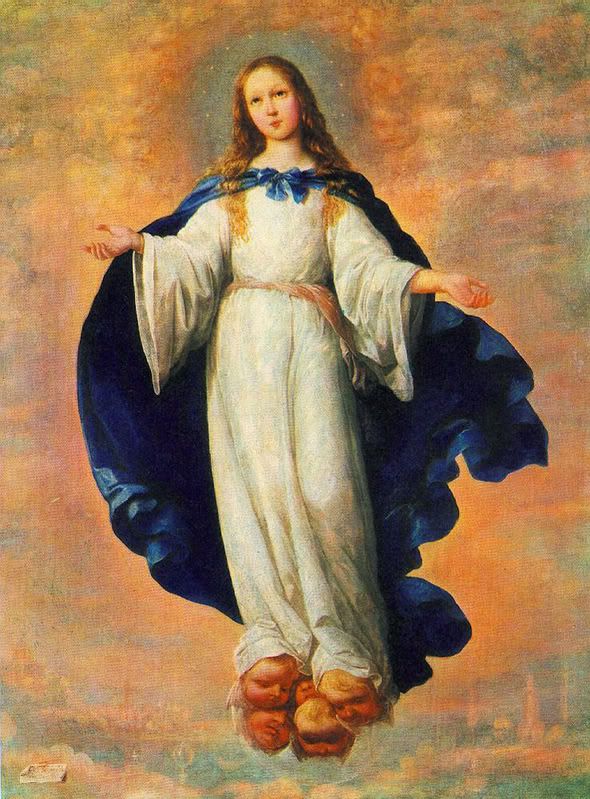
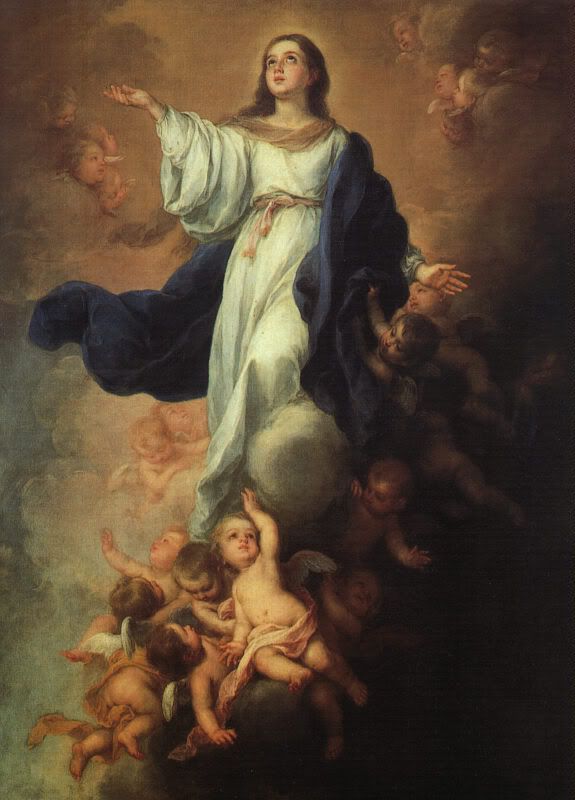
In looking at sacred art and the many images of Mary, it's common to see Mary staring at, pointing to, or holding up the child Jesus for us to adore. And this embodies her role, and provides an image of why it is we ask for her prayers at all. Mary, the first to receive Christ into her body, always helps us to draw closer to Him, she points the way to true union with Him.


Here's a lovely Ave Maria with some beautiful sacred art to accompany it. Enjoy!

Saturday, December 08, 2007

Happy Feast of the Immaculate Conception!

We sang the Lourdes Ave Maria today at mass for the Feast of the Immaculate Conception, which reminded me that I hadn't yet put up a little video I got of the bells at Lourdes ringing the tune.

It's not very long but it's a bit slow to load, sorry!

Wednesday, August 15, 2007

Salve Regina Sing Along!

As I was browsing for Marian videos, I came upon this Salve Regina with words, how neat!

Happy Feast of the Assumption of the Blessed Virgin Mary!

Don't forget to go to mass today!

Meanwhile, enjoy this video on Our Lady:

Friday, December 08, 2006

Happy Feast of the Immaculate Conception!


Today we celebrate the feast of the Immaculate Conception of the Holy Virgin Mary. We do not worship her, rather we worship and praise God for creating her in this way so that Christ, the Word of God Incarnate, would have a pure and holy vessel untouched by sin, just as the Ark of the Covenant, which held the Word of God inside it, was pure and untouched.

Here is more about the Immaculate Conception from Catholic Answers:

It’s important to understand what the doctrine of the Immaculate Conception is and what it is not. Some people think the term refers to Christ’s conception in Mary’s womb without the intervention of a human father; but that is the Virgin Birth. Others think the Immaculate Conception means Mary was conceived "by the power of the Holy Spirit," in the way Jesus was, but that, too, is incorrect. The Immaculate Conception means that Mary, whose conception was brought about the normal way, was conceived without original sin or its stain—that’s what "immaculate" means: without stain. The essence of original sin consists in the deprivation of sanctifying grace, and its stain is a corrupt nature. Mary was preserved from these defects by God’s grace; from the first instant of her existence she was in the state of sanctifying grace and was free from the corrupt nature original sin brings.

When discussing the Immaculate Conception, an implicit reference may be found in the angel’s greeting to Mary. The angel Gabriel said, "Hail, full of grace, the Lord is with you" (Luke 1:28). The phrase "full of grace" is a translation of the Greek word kecharitomene. It therefore expresses a characteristic quality of Mary.

The traditional translation, "full of grace," is better than the one found in many recent versions of the New Testament, which give something along the lines of "highly favored daughter." Mary was indeed a highly favored daughter of God, but the Greek implies more than that (and it never mentions the word for "daughter"). The grace given to Mary is at once permanent and of a unique kind. Kecharitomene is a perfect passive participle of charitoo, meaning "to fill or endow with grace." Since this term is in the perfect tense, it indicates that Mary was graced in the past but with continuing effects in the present. So, the grace Mary enjoyed was not a result of the angel’s visit. In fact, Catholics hold, it extended over the whole of her life, from conception onward. She was in a state of sanctifying grace from the first moment of her existence.


Today is a Holy Day of Obligation, so don't forget to go to mass!

Monday, August 14, 2006

Hail Mary, Full of Grace...

As tomorrow is the Feast of the Assumption of the Blessed Virgin Mary, I thought it appropriate to talk about her, and specifically what Catholics believe concerning her. One major problem many non-Catholics have is our belief in the Immaculate Conception...that is, when they understand that this is talking about Mary and not Jesus! So let me take a moment and explain what it is we believe.

The Immaculate Conception means we believe when Mary was conceived, she was kept from inheriting the state of original sin by a special act of God. This is the analogy most often given to explain it (from the link below):

Suppose a man falls into a deep pit, and someone reaches down to pull him out. The man has been "saved" from the pit. Now imagine a woman walking along, and she too is about to topple into the pit, but at the very moment that she is to fall in, someone holds her back and prevents her. She too has been saved from the pit, but in an even better way: She was not simply taken out of the pit, she was prevented from getting stained by the mud in the first place. This is the illustration Christians have used for a thousand years to explain how Mary was saved by Christ. By receiving Christ’s grace at her conception, she had his grace applied to her before she was able to become mired in original sin and its stain.

Basically, we believe Mary was born in the state that Eve was. We often call Jesus the new Adam for obvious reasons, he helps us out of that pit that Adam fell into in the first place, and we call Mary the New Eve, because while Eve said no to God, Mary said yes. She was really the first person to accept Christ, though in a very literal way, lol! Also, we call Mary the New Ark, because just as the Ark of the Covenant was a vessel that was considered holy, was not to be touched by impure hands, and held within it the most precious and holy of all things on earth, so too did Mary. She had within her the very body of our Lord, and how much more infinitely worthy of being kept free from contact with any vessel that has a stain of sin is He than mere objects! It seems fit that the vessel that was to carry him should be pure and untouched by any kind of sin, even original sin.

Now, where does this idea come from at all? It was not invented in the 1800s, it has been around for a long long time, it was just formally defined in the 1800s. This is an explanation of where we get the idea.

When discussing the Immaculate Conception, an implicit reference may be found in the angel’s greeting to Mary. The angel Gabriel said, "Hail, full of grace, the Lord is with you" (Luke 1:28). The phrase "full of grace" is a translation of the Greek word kecharitomene. It therefore expresses a characteristic quality of Mary.

The traditional translation, "full of grace," is better than the one found in many recent versions of the New Testament, which give something along the lines of "highly favored daughter." Mary was indeed a highly favored daughter of God, but the Greek implies more than that (and it never mentions the word for "daughter"). The grace given to Mary is at once permanent and of a unique kind. Kecharitomene is a perfect passive participle of charitoo, meaning "to fill or endow with grace." Since this term is in the perfect tense, it indicates that Mary was graced in the past but with continuing effects in the present. So, the grace Mary enjoyed was not a result of the angel’s visit. In fact, Catholics hold, it extended over the whole of her life, from conception onward. She was in a state of sanctifying grace from the first moment of her existence.


Now, the Assumption means that we believe Mary was taken into Heaven, both body and soul. (This is in contrast to the Ascension, where Christ ascended into Heaven by His own power...we don't believe Mary ascended by her own power, we believe she was taken, assumed into Heaven, like Elijah.) Interestingly enough, there is no formal declaration on whether or not she actually died before this happened!

So...happy Feast of the Assumption to all you Catholics out there, remember to go to mass as it is a Holy Day of Obligation!

Pax

Friday, August 11, 2006

Prayers to the Saints

As far as praying to Mary, a quick explanation is that we ask Mary and the saints to pray for us, just as we ask family and friends on earth to pray for us, because we believe they are our brothers and sisters in Christ, but they're just up in heaven instead of here on earth, so the only way to ask them to pray for us is to "pray" to them, since we can't ask them face to face. That's why the last part of the Haily Mary is "Pray for us sinners, now and at the hour of our death."

DavidMac: What I don't understand is why pray to someone in heaven other than to God directly?

To put it simply, there's no reason we can't pray to God directly, of course we can, and we SHOULD! But the more people we have praying for us, the better, right? Isn't that why we ask our brothers and sisters in Christ to pray for us in difficult times, etc? And also, since the saints in heaven are closer to Christ than we are, and could actually go and talk to Him in person, we believe it's a good thing to ask for their prayers as well.

We believe in what we call the "community of saints," meaning the collection of saints in heaven and on earth who make up the Church, the Kingdom of God. So yes, we are saints now and will be saints in heaven more perfectly, as we believe we will be pure and holy when in heaven.

As for scriptural evidence, in Revelation 5:8 we see him talk about "golden vials full of odours, which are the prayers of saints" while describing a vision of heaven.

Also, historically, this has been a practice since the first centuries of Christianity. Not that this alone proves it's correct, but we often look at the early church fathers to see what they did then since they were much closer to Christ, as far as a timeline goes, than we are, and therefore probably had a clearer picture of what Christ wanted.

More on the subject.

And even more.