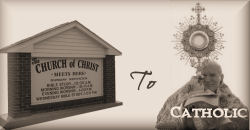
Sunday, March 15, 2009

Venite Adoremus

We move now from God's dwelling place, the tabernacle, to a vessel called a monstrance in which the Eucharist is exposed to us, visible and vulnerable so that we may adore Him. The word monstrance itself comes from the Latin monstrare, which means "to show." It's typically a beautiful and ornate vessel, with a transparent center so that the host which is placed in it can be seen by and shown to those present.

The monstrance is used for several occasions. One is adoration, where the Blessed Sacrament is exposed in the monstrance, and left on the altar so that people can come and pray or simply be in Christ's presence, and adore him. A famous story from the Curé d'Ars, St. Jean Vianney, relates the tale of a peasant who would spend hours apparently doing nothing but sitting quietly in church. When asked what he was doing, he responded, "I look at Him, and He looks at me." This is what many do in adoration. Some pray. Some read scripture or devotionals. Some even sing...recently at adoration, it was calmly quiet as usual, when a lone lady began singing hymns to Our Lord. It was touching, hearing one lone voice echoing in the cathedral in hymns of adoration.

I have a special place in my heart for adoration, as my very first time in a Catholic Church was in the middle of the night during adoration. I wasn't yet 100% convinced of the truth of Catholicism...and before attending my first mass, I took an opportunity to simply check out the church from the inside first. Many parishes will have perpetual adoration, and when this is the case people sign up for typically around hour long slots, so that the exposed Christ is never left alone, even in the dark of the night. There was one or two other people there praying, but what I remember most was a beautiful and surprisingly tangible sense of calm and peace (and this in a quite turbulent time of my life.) This was my first encounter with Christ in the Eucharist, and I look back on it fondly!

Benediction is when the priest takes the Eucharist in the monstrance and blesses the people with it. When he does this, he wears a shawl-like vestment called a humeral veil, to cover his hands when picking up the monstrance so that he doesn't touch it. This is to symbolize the fact that this blessing is not from him, but from Christ present in the Eucharist.


Another use of the monstrance is in a Eucharistic Procession. This is especially common on the feast of Corpus Christi (the Body of Christ.) Once again, the monstrance is held by the priest using the humeral veil, and it is processed outside under a rectangular canopy called a baldachin (which can be seen in the two pieces of artwork which portray a procession). It's quite a powerful way to bring Christ to those in the street.


The following video is one that was made to promote and encourage vocations, but it shows a Eucharistic procession in the streets of New York. The juxtaposition of the modern streets in the background with this long held tradition is really very beautiful.


"In thy presence there is fullness of joy" (Ps 16:11)

"Be still, and know that I am God." (Ps 46:10)

"Can you not watch one hour with me?" (Matt 26:40)

"And all the angels stood round about the throne, and about the ancients, and about the living creatures; and they fell on their faces, and adored God, saying: ‘Amen. Blessing and glory and wisdom and thanksgiving, honor and power and strength to our God forever and ever. Amen’" (Rev 7:11-12).

Come, let us adore Him, indeed!

Saturday, March 14, 2009

God's Dwelling Place

At every mass, during the consecration, we believe Christ becomes truly present to us under the appearance of bread and wine. After we receive the Eucharist, there are typically hosts still leftover, and once they are consecrated, they remain so. We wouldn't dare throw the Eucharist away, and so in every Catholic Church, you could say as the heart of the church is the tabernacle, Christ's dwelling place.

photo by marylea
Once again, this is a Jewish concept brought into Christianity. In Exodus, we first read of Moses asking God to dwell among them (34:9). This is indeed a dangerous thing, and God warns against it at first (33:3) but graciously agrees at Moses' request and acknowledgement of their unworthiness. And so, a tent is set apart as a sacred space to be God's dwelling place. A whole chapter (35) is taken to describe the very detailed requirements for this space. The numbers used and materials used all have great meaning, they all point to wholeness, to purity, and the best stones, linens, metals, and woods are called for. Obviously, this is no light matter, and nothing is too precious for the dwelling place of God! No expense is spared for this most holy of places, and the Tent is brought with the Israelites through the desert.

Later in the Old Testament, the Temple replaces the tent as there is no need for it to be portable any longer. Once again, great care is taken and no expense spared for the building of this Temple. Directions are given in 1 Chorinthians 28, and in the following chapter we can see His dwelling place was to be beautiful, crafted by the best artisans, and created with the wealth given willingly by King David and his people.

But now, because of the delight I take in the house of my God, in addition to all that I stored up for the holy house, I give to the house of my God my personal fortune in gold and silver: three thousand talents of Ophir gold, and seven thousand talents of refined silver, for overlaying the walls of the rooms, for the various utensils to be made of gold and silver, and for every work that is to be done by artisans.(1 Chorinthians 29:3-5)

Sometimes, non-Catholics have a hard time understanding why we often include such ornate and beautiful objects in our churches. The simple answer is because, as Moses and Kind David knew, nothing is too precious for God. If Jesus were coming to one's house to have dinner, I imagine we'd all bring out our best china and crystal, our richest foods...nothing would be too good for God Himself!

And so, the Christian equivalent of the Tent and the Temple, the dwelling place of God, is the Tabernacle. It is often a beautiful and ornate golden box. Outside of every tabernacle is a lamp, called an altar lamp or sanctuary lamp. This lamp is kept lit at all times when the Eucharist is inside to remind us of Christ's presence there. (Also a concept carried over from the Jews, as in Exodus 27:20-21.)

Out of respect, any time one crosses in front of the tabernacle it is customary to bow or genuflect to acknowledge Christ's presence. People are welcome to come and pray, knowing Christ is there. His presence makes it a holy place, and our actions reflect that. The scriptures remind us, too, that our bodies are also to be considered temples of the Holy Spirit. (1 Cor 6:19) We can look to the beautiful tabernacles to remind us of the amazing gift residing within it, so that when we receive it ourselves we recognize our unworthiness and praise God accordingly.


A recent, somewhat controversial issue concerning the tabernacle has to do with its placement in the church. It has become more common to place it off to a side rather than being centrally located, and sometimes even off in a separate room not visible in the main part of the church. It may not seem like a huge deal, but it's likely no coincidence that as the tabernacle became less visible, less central in some places, belief in the Real Presence has seemed to diminish alongside it. Ornate tabernacles replaced with simple wooden boxes could make it easier to forget the precious gift that is dwelling within it. We are physical creatures, and physical attributes remind us of spiritual truths.

The video below shows some examples of tabernacles, both some modern simplistic tabernacles placed off to the side, and more ornate tabernacles cenntrally located. At the end of the day of course, what matters is what is inside...God Himself, who humbly comes to us in the form of bread and wine. May we never forget what a precious gift this is!


How lovely is your dwelling place, O Lord Almighty.
I long, yes, I faint with longing to enter the courts of the Lord. With my whole being, body and soul, I will shout joyfully to the living God.
Even the sparrow finds a home there, and the swallow builds her nest and raises her young at a place near your altar, O Lord Almighty, my King and my God!
How happy are those who can live in your house, always singing your praises.
(Ps 84:1-4)

And the Word became flesh and made his dwelling among us, and we saw his glory, the glory as of the Father's only Son, full of grace and truth. (John 1:14)

After this I will return and will rebuild the tabernacle of David, which has fallen down; I will rebuild it’s ruins, and I will set it up so that the rest of mankind may seek the Lord, even all the Gentiles who are called by My name, says the Lord who does all these things. (Acts 15:16-17)

Thursday, March 12, 2009

God's Holy Altar

A prominent and central object in every Catholic Church is the altar. This is where the bread and wine are transformed into the Body and Blood of Christ, He who is both sacrificial victim and High Priest.

As this article explains,

The Christian altar is one of the earliest elements of the liturgy. In the first years when Christianity was illegal, the Eucharist was typically celebrated in the homes of the faithful. The altar could have been the dinner table in the home or the wooden chest in which a bishop would carry needed materials for celebrating the Eucharist from place to place.

Fixed altars made of stone became prevalent when Constantine established that Christianity would no longer be illegal and more churches were erected for the purpose of celebrating the Mass...

Early altars were not placed against walls, but set apart so that the bishop or priests would stand facing the people. Around the 5th century, it became popular for the altar to face the East or be set against a wall. The priest would celebrate the Mass facing east, and the people would face East with him, symbolic of looking toward Christ as the Dawn. In the Middle Ages, the altar ceased to resemble the table of the early Church. Altars of Medieval times began to be designed very ornately, and were adorned with statues, relics, and paintings, and of course the tabernacle. In the mid-20th century, in many countries, the altar was moved away from the wall again, with the priest celebrating the Mass facing the people.

As for the meaning behind the altar, it reaches back to Jewish times and the sacrifices done to atone for sins. Some Christians feel that such a thing is no longer relevant to Christians, but as we believe Christ didn't come to destroy the law, but to fulfill it, we see the Eucharist as the intended perfect sacrifice for which the Jewish peoples were prepared for so long.

The Catholic altar is both a sacrificial altar, and a table for a communal meal. In Jesus’s time, altars where animal sacrifices took place as atonement for sin were common under Jewish norms and traditions. The passion of Christ was the ultimate sacrifice, to atone for the sin of mankind. Therefore, the Christ’s sacrifice is enacted each Mass at an altar. The altar is also a table because we are all “called to the Lord’s supper.” The sense of the Catholic altar as a table calls to mind the last supper and the tables around which the early Christians celebrated the Eucharist, as well as the fact that we as a faithful community are sharing in the saving meal.

The altar is traditionally made of stone, calling to mind Christ as the living cornerstone of the Catholic faith:

“So then you are no longer strangers and sojourners, but you are fellow citizens with the saints and members of the household of God, built upon the foundation of the apostles and prophets, Christ Jesus himself being the cornerstone” (Ephesians 2:19-20)

“Come to him, to that living stone, rejected by men but in God's sight chosen and precious; and like living stones be yourselves built into a spiritual house, to be a holy priesthood, to offer spiritual sacrifices acceptable to God through Jesus Christ. For it stands in scripture: "Behold, I am laying in Zion a stone, a cornerstone chosen and precious, and he who believes in him will not be put to shame.” (1 Peter 2:4-6)

Some more scripture related to altars:

Then Jeshua, son of Jozadak, together with his brethren the priests, and Zerubbabel, son of Shealtiel, together with his brethren, set about rebuilding the altar of the God of Israel in order to offer on it the holocausts prescribed in the law of Moses, the man of God. Despite their fear of the peoples of the land, they replaced the altar on its foundations and offered holocausts to the LORD on it, both morning and evening. (Ezra 3:2-3)

Do you not know that those who perform the temple services eat (what) belongs to the temple, and those who minister at the altar share in the sacrificial offerings?
In the same way, the Lord ordered that those who preach the gospel should live by the gospel.
(1 Cor 9:13-14)

When he broke open the fifth seal, I saw underneath the altar the souls of those who had been slaughtered because of the witness they bore to the word of God. (Rev 6:9)

Another angel came and stood at the altar, holding a gold censer. He was given a great quantity of incense to offer, along with the prayers of all the holy ones, on the gold altar that was before the throne. (Rev 8:3)

Then the sixth angel blew his trumpet, and I heard a voice coming from the [four] horns of the gold altar before God (Rev 9:13)

Wednesday, March 11, 2009

American Idol?

I'm going to take the easy way out this time and just post a video! This is another episode of That Catholic Show, called Statues and Icons. Enjoy!

Tuesday, March 10, 2009

Via Dolorosa

When you walk into a Catholic church, one of the things you may notice along the walls is a series of pictures or engravings of Jesus in various states with roman numerals above them. These are called the Stations of the Cross, or the Way of the Cross. If you've seen Mel Gibson's The Passion of the Christ, you'd likely recognize the sequence and various scenes depicted. These scense are based on both Scripture and Tradition. Especially during Lent, and particularly on Fridays of Lent, it is a common practice in most parishes to pray the stations one by one and reflect on each one as they go.

This practice originated in the Holy Land, where the Via Dolorasa (the Way of Sorrows) has long been travelled by people following what are believed to be Christ's footsteps on His way to the crucifixion, recalling His Passion along the way.

The stations are as follows, accompanied by an image of each scene, and scripture and prayer to accompany it. There is often a reflection on each event as well, and a hymn called the Stabat Mater sung between each one, but in the interest of brevity I'm leaving them off. If you'd like, here are the commonly used reflections from St. Alphonsus Liguori.

I - JESUS IS CONDEMNED TO DEATH

We adore you O Christ and we bless you
Because by your holy cross you have redeemed the world.


Matthew 27:22-26

Pilate said to them, ‘Then what should I do with Jesus who is called the Messiah?’ All of them said, ‘Let him be crucified!’ Then he asked, ‘Why, what evil has he done?’ But they shouted all the more, ‘Let him be crucified!’

So when Pilate saw that he could do nothing, but rather that a riot was beginning, he took some water and washed his hands before the crowd, saying, ‘I am innocent of this man’s blood; see to it yourselves.’ Then the people as a whole answered, ‘His blood be on us and on our children!’ So he released Barabbas for them; and after flogging Jesus, he handed him over to be crucified.


II - JESUS RECEIVES HIS CROSS

We adore you O Christ and we bless you
Because by your holy cross you have redeemed the world.


Mark 15:16-20

Then the soldiers led him into the courtyard of the palace (that is, the governor’s headquarters); and they called together the whole cohort. And they clothed him in a purple cloak; and after twisting some thorns into a crown, they put it on him. And they began saluting him, ‘Hail, King of the Jews!’ They struck his head with a reed, spat upon him, and knelt down in homage to him. After mocking him, they stripped him of the purple cloak and put his own clothes on him. Then they led him out to crucify him.


III - JESUS FALLS FOR THE FIRST TIME

We adore you O Christ and we bless you
Because by your holy cross you have redeemed the world.


John 12: 23-25

Jesus answered them, ‘The hour has come for the Son of Man to be glorified. Very truly, I tell you, unless a grain of wheat falls into the earth and dies, it remains just a single grain; but if it dies, it bears much fruit. Those who love their life lose it, and those who hate their life in this world will keep it for eternal life.


IV - JESUS MEETS HIS MOTHER

We adore you O Christ and we bless you
Because by your holy cross you have redeemed the world.


Luke 2:22, 25, 34, 35

When the time came for their purification according to the law of Moses, they brought him up to Jerusalem to present him to the Lord.

Now there was a man in Jerusalem whose name was Simeon; this man was righteous and devout, looking forward to the consolation of Israel, and the Holy Spirit rested on him. Then Simeon blessed them and said to his mother Mary, ‘This child is destined for the falling and the rising of many in Israel, and to be a sign that will be opposed so that the inner thoughts of many will be revealed—and a sword will pierce your own soul too.’


V - SIMON OF CYRENE HELPS JESUS TO CARRY HIS CROSS

We adore you O Christ and we bless you
Because by your holy cross you have redeemed the world.


Luke 23:26

As they led him away, they seized a man, Simon of Cyrene, who was coming from the country, and they laid the cross on him, and made him carry it behind Jesus.


VI - VERONICA WIPES THE FACE OF JESUS

We adore you O Christ and we bless you
Because by your holy cross you have redeemed the world.


Matthew 25: 25-36, 40

"for I was hungry and you gave me food, I was thirsty and you gave me something to drink, I was a stranger and you welcomed me, I was naked and you gave me clothing, I was sick and you took care of me, I was in prison and you visited me." And the king will answer them, "Truly I tell you, just as you did it to one of the least of these who are members of my family, you did it to me."


VII - JESUS FALLS A SECOND TIME

We adore you O Christ and we bless you
Because by your holy cross you have redeemed the world.


Isaiah 53:7

He was oppressed, and he was afflicted,
yet he did not open his mouth;
like a lamb that is led to the slaughter,
and like a sheep that before its shearers is silent,
so he did not open his mouth.


VIII - JESUS MEETS THE WOMEN OF JERUSALEM

We adore you O Christ and we bless you
Because by your holy cross you have redeemed the world.


Luke 23:27-28

A great number of the people followed him, and among them were women who were beating their breasts and wailing for him. But Jesus turned to them and said, ‘Daughters of Jerusalem, do not weep for me, but weep for yourselves and for your children, for indeed, the days are coming when people will say, 'Blessed are the barren, the wombs that never bore and the breasts that never nursed.'


IX - JESUS FALLS A THIRD TIME

We adore you O Christ and we bless you
Because by your holy cross you have redeemed the world.


John 15:18-20

‘If the world hates you, be aware that it hated me before it hated you. If you belonged to the world, the world would love you as its own. Because you do not belong to the world, but I have chosen you out of the world—therefore the world hates you. Remember the word that I said to you, "Servants are not greater than their master." If they persecuted me, they will persecute you; if they kept my word, they will keep yours also.


X - JESUS IS STRIPPED OF HIS GARMENTS

We adore you O Christ and we bless you
Because by your holy cross you have redeemed the world.


Mark 15:22-24

Then they brought Jesus to the place called Golgotha (which means the place of a skull). And they offered him wine mixed with myrrh; but he did not take it. And they crucified him, and divided his clothes among them, casting lots to decide what each should take.


XI - JESUS IS NAILED TO THE CROSS

We adore you O Christ and we bless you
Because by your holy cross you have redeemed the world.


Luke 23:35, 49

Pilate also had an inscription written and put on the cross. It read, ‘Jesus of Nazareth, the King of the Jews.’ Many of the Jews read this inscription, because the place where Jesus was crucified was near the city; and it was written in Hebrew, in Latin, and in Greek. Then the chief priests of the Jews said to Pilate, ‘Do not write, "The King of the Jews", but, "This man said, I am King of the Jews." ’ Pilate answered, ‘What I have written I have written.’


XII - JESUS DIES

We adore you O Christ and we bless you
Because by your holy cross you have redeemed the world.


Matthew 27: 45- 46

From noon on, darkness came over the whole land until three in the afternoon. And about three o’clock Jesus cried with a loud voice, ‘Eli, Eli, lema sabachthani?’ that is, ‘My God, my God, why have you forsaken me?’

Luke 23: 44-46

It was now about noon, and darkness came over the whole land until three in the afternoon, while the sun’s light failed; and the curtain of the temple was torn in two. Then Jesus, crying with a loud voice, said, ‘Father, into your hands I commend my spirit.’ Having said this, he breathed his last.


XIII - JESUS IS TAKEN DOWN FROM THE CROSS

We adore you O Christ and we bless you
Because by your holy cross you have redeemed the world.


Mark 15:42-45

When evening had come, and since it was the day of Preparation, that is, the day before the sabbath, Joseph of Arimathea, a respected member of the council, who was also himself waiting expectantly for the kingdom of God, went boldly to Pilate and asked for the body of Jesus. Then Pilate wondered if he were already dead; and summoning the centurion, he asked him whether he had been dead for some time. When he learned from the centurion that he was dead, he granted the body to Joseph. Then Joseph bought a linen cloth, and taking down the body, wrapped it in the linen cloth.


XIV - JESUS IS LAID IN THE TOMB

We adore you O Christ and we bless you
Because by your holy cross you have redeemed the world.


Mark 15:46-47

Joseph then laid the body in a tomb that had been hewn out of the rock. He then rolled a stone against the door of the tomb. Mary Magdalene and Mary the mother of Joses saw where the body was laid.