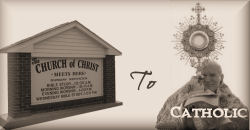
On my board recently, a discussion was revived concerning John 6 and the question of whether or not Christ meant "this is my body" literally. The discussion eventually turned to the Early Church Fathers and what the most common belief regarding this was among them. Unfortunately the CoC participant felt he could no longer dialogue with us and had not yet been able to study what the Early Church's view was to be able to present evidence that supported the CoC view. So I was intrigued when, by a complete coincidence, I stumbled upon an article written by a CoC member concerning this very subject.
The author starts off explaining his view of the use of human history in the Christian faith.
"There is also human history to consider. Though it does not carry the same weight as Scripture, still, to consider how others responded to what God has done among us helps us, and the closer in time to the divine act the better."
The author mentions that the term Eucharist is often used among these early writers...the very term Catholics have used continually. He mentions that the "president" or "presider" was the one who led the "Lord's Supper" and equates it to the brother appointed to "head" the Lord's Table.
Seems to me to fit closer to a priest!
He says that Justin Martyr makes it clear that the Eucharist is to be taken every Sunday (which is also a Catholic belief.) He also mentioned that deacons take the "blessed" communion to those who couldn't come to receive it (also a Catholic practice, especially concerning the "blessed" part.)
The author claims that...
"The idea that the bread and fruit of the vine become literally the flesh and blood of Jesus, sacrificed anew [an incorrect representation of the Catholic belief] on the altar of the Presence [?] by the priest, is not found among these men. It is clear that they speak of commemoration and celebration, not transubstantiation."
I was intrigued to read this, looking forward to his evidence. More on that in just a bit.
Furthermore, he goes on to say...
"Yet there was a heresy at work that demanded of these church leaders (or so they thought) a stress on the reality of the symbol of Christ's presence at the Lord's Supper that some might consider today overreaching, or at least, extravagant."
Umm...I'm really not quite sure what it means to "stress the reality of the symbol." I think he's trying to account for the very literal language they use, but I'm disappointed to see such a claim without much evidence at all to support it.
"There seemed to be, at least among some, an invitation to confess sin offered by the president at every service; and this was to be done before the Lord's Supper was served, so that all might partake worthily."
Ring any bells, fellow Catholics? At the beginning of every mass, the priest leads us in calling to mind our sins and asking for forgiveness. "I confess to almighty God, and to you my brothers and sisters...." Y'all know the rest I'm sure!
Now, I'm going to take a look at some of the quotes of the Early Church Fathers that were provided as support for the CoC view.
"And on the day called Sunday, there is a gathering together in the same place of all who live in a city or rural district...And, as I said before, when we cease from our prayer, bread is presented, and wine and water. The president in the same manner sends up prayers and thanksgivings according to his ability, and the people sing out their assent, saying the Amen. A distribution and participation of the elements for which thanks have been given is made to each person, and to those who are not present it is sent by the deacons," (Justin Martyr [ca. 156], Apology, 1, 67).
Once again, sounds very much like mass...where the wine and water are brought, and mixed, prayers are said, the people respond with Amen.
I found it interesting that on the CoC forum where this was being discussed, one person said:
"I am a little confused that one of the writers in the article said that during the communion they not only had the bread and fruit of the vine but also gave out water. I wonder if this was to assist in the need to drink something afterwards or if this was something added in addition, maybe as a result of the scriptures about being saved in Jesus through not only blood but also water, which we know is baptism but I am curious about this. Anyone know about this in any detail?"
If he were Catholic he would have known the significance of the water and wine right away!
But as for the quote from Justin Martyr, there's nothing contrary to Catholicism there, and from other writings of Justin Martyr we know that he did indeed believe in the real presence and was thoroughly Catholic.
Take the following quote (from here):
For not as common bread nor common drink do we receive these; but since Jesus Christ our Savior was made incarnate by the word of God and had both flesh and blood for our salvation, so too, as we have been taught, the food which has been made into the Eucharist by the Eucharistic prayer set down by Him, AND BY THE CHANGE OF WHICH our blood and flesh is nourished, IS BOTH THE FLESH AND THE BLOOD OF THAT INCARNATED JESUS. (First Apology 66)
Food that is "made into" the Eucharist by the Eucharistic prayer, a "change," food which IS the flesh and blood of Jesus...sounds like a belief transubstantiation/the Real Presence to me!
Moving onto some other quotes in the article...
No one is to eat or drink of your eucharist except those who have been baptized in the name of the Lord... Having earlier confessed your sins so that your sacrifice may be pure, come together each Lord's Day of the Lord, break bread, and give thanks, (The Teaching [ca. 110]).
This is from The Teaching of the Twelve Apostles, otherwise known as the Didache.
Is this text, as a whole, closer to CoC or Catholic views? It's one of the earliest extra-biblical Christian texts we have! But what is this about a sacrifice? The CoC says that the sacrifice is over and done with and we simply remember it...but this text seems to talk about a recurring sacrifice. Here's another quote from the Didache that wasn't included above:
For this is that which was spoken by the Lord: "In every place and time offer to me a pure SACRIFICE; for I am a great King, says the Lord, and my name is wonderful among the nations."
The mass is a sacrifice, it does not sacrifice Christ anew but taps into the ever-present, eternal, perpetual sacrifice that was made once and for all. Therefore, this text seems to support the Catholic idea of the Eucharist as a sacrifice rather than the CoC idea of simply a symbolic memorial.
Furthermore, the Didache definitely does not match up with the CoC view of immersion as absolutely necessary for baptism.
Chapter 7. Concerning Baptism. And concerning baptism, baptize this way: Having first said all these things, baptize into the name of the Father, and of the Son, and of the Holy Spirit, in living water. But if you have no living water, baptize into other water; and if you cannot do so in cold water, do so in warm. But if you have neither, POUR OUT WATER THREE TIMES UPON THE HEAD INTO THE NAME OF THE FATHER AND SON AND HOLY SPIRIT. But before the baptism let the baptizer fast, and the baptized, and whoever else can; but you shall order the baptized to fast one or two days before.
No CoC person worth his salt would accept pouring water on someone's head as a valid baptism!
It seems clear to me that the document taken as a whole appears to be Catholic, not CoC.
Moving onto the next quote...
Be careful, therefore, to employ one eucharist, for there is one flesh of our Lord Jesus Christ and one cup for unity with his blood, one altar, as there is one bishop with the presbytery and deacons, who are my fellow servants, in order that whatever you do may be done according to God, (Ignatius [ca. 112], Philadelphians, 4).
This is one that could apply to CoC or Catholic fairly equally, although I'd have to say that the mention of an altar and "one bishop" tips it a bit towards the Catholic view. Since the CoC doesn't present a sacrifice, they don't really have an altar, they have a table. And of course a plurality of elders is a must according to the CoC.
Furthermore, we know without a doubt that Ignatius was most certainly Catholic (his famous quote, "Where the bishop is, there let the people be, just as where Jesus Christ is, there is the Catholic Church," is the first known instance of the term Catholic Church being used), and that he believed in the Real Presence, as can be seen in the following quotes:
I have no taste for corruptible food nor for the pleasures of this life. I desire the Bread of God, WHICH IS THE FLESH OF JESUS CHRIST, who was of the seed of David; and for drink I DESIRE HIS BLOOD, which is love incorruptible. (Letter to Romans 7:3)
They [i.e. the Gnostics] abstain from the Eucharist and from prayer, because they do not confess that THE EUCHARIST IS THE FLESH OF OUR SAVIOR JESUS CHRIST, flesh which suffered for our sins and which the Father, in his goodness, raised up again. (Letter to Smyrna 7:1)
[As a side note, the whole idea of having one bishop most certainly did not come wholly from St. Ignatius as claimed in the article, and his "proof" that people fought against having one bishop or thought it was wrong from the Shepherd of Hermas is not very convincing, to say the least. But for now I'd like to focus on the Eucharist and not get sidetracked with Church hierarchy.]
Moving on to the next quote...
How can they be consistent with themselves when they say the bread for which they give thanks is the body of their Lord and the cup his blood, if they do not say he is the Son of the Creator of the world?...Let them either change their views or avoid offering the bread and wine. But our view is in harmony with the eucharist, and the eucharist confirms our view, (Irenaeus [ca. 160], Against Heresies, vol. 4; ch. 18; 4, 5).
Honestly, I'm not quite sure what this quote is being used to support in the CoC view. So I'll just say that it's very clearly Catholic! Those who do not profess Christ as the Son of God are not being consistent when they say their bread is His Body and their cup is His Blood, it seems they're playing copy cat but not accepting the Whole Truth. Likewise, Catholics ARE being consistent, our view is "in harmony with the eucharist, and the eucharist confirms our view."
Here is more from the same document by Irenaeus, Against Heresies, which clearly shows his belief in the Real Presence:
Then, again, how can they say that the flesh, which is nourished WITH THE BODY OF THE LORD AND WITH HIS BLOOD, goes to corruption, and does not partake of life? Let them, therefore, either alter their opinion, or cease from offering the things just mentioned. But our opinion is in accordance with the Eucharist, and the Eucharist in turn establishes our opinion. For we offer to Him His own, announcing consistently the fellowship and union of the flesh and Spirit. For as the bread, which is produced from the earth, when it receives the invocation of God, IS NO LONGER COMMON BREAD, BUT THE EUCHARIST, CONSISTING OF TWO REALITIES, EARTHLY AND HEAVENLY; so also our bodies, when they receive the Eucharist, are no longer corruptible, having the hope of the resurrection to eternity. (4:18:5)
If the BODY be not saved, then, in fact, neither did the Lord redeem us with His BLOOD; and neither is the cup of the EUCHARIST THE PARTAKING OF HIS BLOOD nor is the bread which we break THE PARTAKING OF HIS BODY...He has declared the cup, a part of creation, TO BE HIS OWN BLOOD, from which He causes our blood to flow; and the bread, a part of creation, HE HAS ESTABLISHED AS HIS OWN BODY, from which He gives increase to our bodies.
When, therefore, the mixed cup and the baked bread receives the Word of God and BECOMES THE EUCHARIST, THE BODY OF CHRIST, and from these the substance of our flesh is increased and supported, how can they say that the flesh is not capable of receiving the gift of God, WHICH IS ETERNAL LIFE -- flesh which is nourished BY THE BODY AND BLOOD OF THE LORD...receiving the Word of God, BECOMES THE EUCHARIST, WHICH IS THE BODY AND BLOOD OF CHRIST... (5:2:2-3)
Seems pretty clear where he stood on the issue!
Ok, the last two quotes seem to be trying to prove that the early Christians did not believe the Eucharist to be the actual Body and Blood of Christ, but rather a "memorial" and nothing more.
The first quote is from Tertullian:
Taking bread and distributing it to his disciples, he made it his own body by saying, "This is my body," that is "a figure of my body." On the other hand, there would not have been a figure unless there was a true body. (Tertullian [ca. 200], Against Marcion, 4, 40).
At first glance, with our modern understanding, this would seem to imply that Tertullian does favor a symbolic view of the Eucharist.
However, the problem here is precisely the fact that we're reading into the words our modern understanding, rather than trying to understand what Tertullian meant.
In the text above, Tertullian is arguing against Marcion, who believed that Christ did not have an actual body, but was just spirit. Tertullian is using the Eucharist as proof that Christ did indeed have a body. After all, what kind of "figure" of Christ's body would the Eucharist be if Christ had no actual body?
First I'd remind everyone that Catholics DO believe that the Eucharist is symbolic. We simply don't believe it is merely or only symbolic, we believe it is both symbolic and actual, the way that we believe baptism is both symbolic and actual. So to begin with, even if Tertullian did mean to say, in the above quote, that the Eucharist is symbolic (in the sense that we mean it today), this would not be a contradiction to Catholic teaching, especially because, as we'll see in just a minute, elsewhere Tertullian definitely shows a believe in the Real Presence.
But the most important point is that "figure" in Tertullian's quote is not equivalent to our modern day idea of a mere symbol. This article goes into much more detail explaining the difference, but here is a short explanation:
"A scholar of great authority as to the meaning of early Latin documents has inferred from these facts that in Tertullian 'figura' is equivalent not to -schema- but to -charakter- [see Turner, Journal of Theological Studies, vii,596], that is, it would approach more nearly to 'ACTUAL and distinctive NATURE' than to 'symbol' or 'figure' in the modern sense of those terms.
"The question of the meaning of such words in connection with the Eucharist will recur again in a later period. It may be sufficient here to express the warning that to suppose that 'symbol' in Clement of Alexandria or 'figure' in Tertullian must mean the same as in modern speech would be to assent to a line of thought which is GRAVELY MISLEADING." (Stone, vol 1, pg 31)
Now, another way to know whether Tertullian really meant the Eucharist is merely symbolic rather than both symbolic and truly the Body and Blood of Christ is to examine what he says about the Eucharist elsewhere. Let's take a look:
Likewise, in regard to days of fast, many do not think they should be present at the SACRIFICIAL prayers, because their fast would be broken if they were to receive THE BODY OF THE LORD...THE BODY OF THE LORD HAVING BEEN RECEIVED AND RESERVED, each point is secured: both the participation IN THE SACRIFICE... (Prayer 19:1)
The flesh feeds on THE BODY AND BLOOD OF CHRIST, so that the SOUL TOO may fatten on God. (Resurrection of the Dead 8:3)
It seems clear that Tertullian did indeed believe in the Real Presence from the above quotes.
The final quote in the article is, I suppose, an attempt to show that the Early Christians did not consider the Eucharist to be really the Body and Blood of Christ because it is not "another sacrifice" but a "memorial."
It is evident to those educated in divine things that we do not offer another sacrifice, but we perform the memorial of that one saving sacrifice, (Theodoret [ca. 440], Interpretation of Hebrews, 8:4, 5).
The problem is that, once again, this reveals an underlying assumption that something cannot be a memorial and also real, as well as a fundamental misunderstanding of the Catholic teaching about the Eucharistic sacrifice. Indeed, the above quote fits exactly with the Catholic understanding that we do NOT re-sacrifice Christ on the altar, rather, the Once and for all sacrifice is re-presented, made present again for us on the altar. It is a true memorial, a memorial which does not just bring to mind the event celebrated, but also makes it truly present.
Once again, if we look at other writings of Theodoret, we can see he did indeed believe in the Real Presence.
From a dialogue he wrote:
Eran.—What do you call the gift which is offered before the priestly invocation?
................
Orth.—Food of grain of such a sort.
Eran.—And how name we the other symbol?
Orth.—This name too is common, signifying species of drink.
Eran.—And after the consecration how do you name these?
Orth.—CHRIST'S BODY AND CHRIST'S BLOOD.
Eran.—And do you believe that you partake of Christ's body and blood?
Orth.—I do.
Eran.—As, then, the symbols of the Lord's body and blood are one thing before the priestly invocation, and after the invocation are changed and become another thing...
Orth.—...even after the consecration the mystic symbols are not deprived of their own nature; they remain in their former substance figure and form; they are visible and tangible as they were before. But they are regarded as what they are become, and believed so to be, and are worshipped as being what they are believed to be. Compare then the image with the archetype, and you will see the likeness, for the type must be like the reality.
This describes our understanding of the substance and accidents of the Eucharist and the change that takes place, and only makes sense if they are speaking of the Eucharist and the Real Presence, not if they're speaking of a merely symbolic "Lord's Supper" in which no change takes place, and no consecration exists.
So among the quotes presented, we see that where they support the CoC view, the CoC is in agreement with the Catholic Church. We see that none of the quotes contradict the Catholic understanding of the Eucharist, in fact they fit right in with it. Furthermore, in cases where the specific quotes presented from certain Early Church Fathers could be interpreted either way, we can see from their other writings that they did believe in the Real Presence, and so these quotes must be interpreted in light of that belief.
The author of the article ends by saying:
"No one should build his faith or religious practice on the words of mere men. But using the Bible as the standard, drawing our conclusions only from there, we then turn to the words of later saints to hear their understanding. When we find ourselves in such concert, over so many centuries, it can only thrill and strengthen the faithful in Christ. For it is obvious we and all who follow the apostolic pattern are the one and the same church of Christ."
Indeed, it is thrilling to see Christians through the ages who profess the same beliefs as we do today. Unfortunately for the author, none of the early Christians he quoted do profess exactly the same faith as the CoC, and certainly not concerning the Eucharist, as I've shown. And in general, members of the CoC are not content to affiliate themselves with those with whom they only partially agree, nor should they be. But to be consistent, they can't claim these Early Church Fathers as their own any more than they can claim members of various modern denominations as their own just because they happen to agree on some issues.
The same Church of Christ that these early Christians belonged to is not the one that came from the restoration movement. It is clearly the Catholic Church.
Showing posts with label Apologetics. Show all posts
Showing posts with label Apologetics. Show all posts
Sunday, November 04, 2007

Friday, July 27, 2007
John Martignoni vs CoC
Erik, from my board, has found another gem of a debate. On this one, John Martignoni of the Bible Christian Society is a guest on an internet radio show run by CoC members. I very much enjoyed listening to this, it's about an hour long, and I have to add that I think the CoC hosts were very respectful, even in disagreement, and were fair in letting John have his say without unnecessarily cutting him off (like some radio folks out there do). I would have used some different word choices than John did at times to explain things in a way I know CoC people could understand better, but that's not his fault, as you can't really know that kind of thing unless you've been CoC yourself! Overall, I think he did a great job.
Thanks again, Erik!
Thanks again, Erik!
Sunday, January 14, 2007
Believe That You May Understand...
The past week or so, I've been engaged in a discussion with some fellow ex-ers who ended up losing faith in God. I have to admit that I have a hard time understanding what it's like not to have faith in God, because for some reason, despite my turbulent conversion, that never happened to me. That was the one thing that I clung to when I was confused and scared...my faith in God. It honestly never crossed my mind to doubt His existence. And so, sometimes it's hard for me to discuss with those who have lost faith, because I want to understand them and to be able to communicate with them effectively, but I think there are obstacles to effective communication on both sides.
On my side, it's because, as I mentioned, I can't really grasp what it's like not to believe in God, and I have a hard time relating to their disbelief, which in turn makes it hard for me to explain my own belief in a way they can understand or relate to. On their side, depending on who I'm discussing with, the fact that I never seriously doubted God's existence may cause them to consider anything I say to be tainted with ignorance or naïveté. (I have to say that I am very fortunate to know some very respectful atheists and agnostics who, even if they might think this about me, refrain from using it as an excuse or an attack, and at least seem to thoughtfully consider my remarks.) Obviously, I can't do anything about the latter obstacle, but I can at least try to understand where they are coming from a bit better. So, I decided to read what some former atheists have to say on the matter!
This led me to a couple blogs, namely Et-tu, Jen? and Chez Joel. After spending way too much time devouring the contents of blog posts related to atheism and God's existence and proving His existence (or not), I think I finally started to discover better ways to describe the differences between evidence and proof, what it is to have faith, to believe, and why such things are even necessary when discussing with my atheist friends. (At least, things are a little less muddled in my own head now, even if I haven't necessarily helped them!)
Evidence vs. Proof
I was first trying to find a way to explain the difference between evidence and proof. I hear a lot about wanting "proof" of something, but when I say that there will never be proof, I often get responses like, "Well then why shouldn't I believe that fairies are what make the world go round?" or the like. But when I say there won't be proof, I'm not saying there won't be evidence. It's just that, because of the nature (or "super" nature) of God, we can't always demand natural evidence, or scientific evidence, we need to be open to considering supernatural or anecdotal evidence. If someone rules out this kind of evidence to begin with, they're closing the case before giving it a chance. One of the blog posts that helped me on this point was from Jennifer's blog on proof.
Atheists often accuse the religious of having different (specifically subpar) standards for evidence when it comes to belief in God. It seems to me, though, that it is the atheists who hold religion and the existence of God to an impossibly high standard, compared to many other things in everyday life, and then complain (or rejoice, depending) when the evidence fails to meet their standards. And yet these standards are not used on other equally unprovable things in life, such as love. Just as we can't prove scientifically the existence of love, we can't prove scientifically the existence of God. Yet because of evidence I have seen in my life, I believe both exist, and I simply don't find this unreasonable or irrational.
Belief
During the course of our discussion, the proposition was made that belief is a choice. Of course, again, the agnostics/atheists of the group say, "Well I'm sorry, but I can't choose to believe in God anymore than I can choose to believe that fairies make the world go round." It seemed to me that they often equate belief or faith with feelings...and this got me thinking about love.
Just as atheists say "I can't make myself believe," many people today say, "I can't make myself love." But what they mean by this is they can't conjure up fuzzy warm feelings. But I believe that real love is a choice...if it weren't, there's no way we could promise to love our spouse for the rest of our lives in our wedding vows. (In fact, I propose that this widespread understanding of love as merely an uncontrollable feeling is partly responsible for the current divorce rate.)
Then I started to wonder, what is belief anyway? If it's not just a feeling, what is it? I found a wonderful answer in a post called How to Find God in Three Arduous Steps on Chez Joel. He said:
To believe is not to change your mind, or your feelings. It's no good to trick yourself into thinking differently. To believe is simply to act on the assumption that something is true.
This!! THIS is what I had been looking for!
The quote from St. Augustine immediately jumped to mind, "Seek not to understand that you may believe, but believe that you may understand."
I know the atheist doesn't like to hear this, and often sees it as a cop out, or as a form of brainwashing, or something along those lines. But if we look at this quote as it applies to love, I think it holds true there as well. If we tweak the quote a bit, and change just one word, we can say, "Seek not to understand that you may love, but love that you may understand."
Do we expect people who have never experienced love to understand it? I mean, it often defies explanation...how can people be self sacrificing and self giving? Why would they do such things, what are they getting out of it? It doesn't really make sense, no one can study love enough to understand it, you have to believe in love, to act on the assumption that it is true, to experience it, before you really understand it. But I don't see people demanding "proof" that love exists before acting as if it does the way they demand proof that God exists, and yet it's not considered unreasonable to make that leap when it comes to love, presumably because most of us experience it from a very early age.
Miracles
Another commonly mentioned argument is the "God, I would believe in you if..." argument. (Once again, Jen's blog was extremely helpful!)There are some very good points made about how even a miracle wouldn't be proof enough, because doubts arise, and eventually we would just want more proof. Certainly God could hand deliver miracles on demand if He wanted, so the fact that He doesn't should push us to consider the possibility that there must be a reason. What does God get out of wanting us to make a leap of faith? What do we get out of having to make that leap of faith? Perhaps taking our example of love, once again, can help us understand.
So many people say, "I would only believe if I could just have one miracle," but what if we asked a potential spouse before we agreed to marriage, "I will believe your love for me exists, and act as if it's true, only if you prove it to me first." This would be virtually impossible, there would be no way to definitively prove such a thing. Part of the beauty of marriage vows is the mutual vulnerability, because this turns into a strength as trust is built and love grows, but the vulnerability must come first. As scary as it is, it is this vulnerability, this surrender that God wants to be able to help us grow...this humility, this is the fertile soil needed to be able to plant that seed of faith. It's only when we recognize our inability to do it ourselves, when we acknowledge the intellect alone isn't enough, it's only when we submit, when we ask God for the faith we need to believe that we can even begin to understand. We simply can't do it on our own, and if we expect or demand to understand before we believe, we'll only end up disappointed.
Friday, January 12, 2007
Catholicism and Pelagianism
I was asked by a fellow ex-er to explain why Catholicism isn't Pelagian. This is a good question, because it's actually a common claim against Catholicism (despite the fact that it was the Catholic Church who originally rejected Palagianism as heresy!)
So, Pelagianism says that because we have free will, grace is unnecessary, you just have to choose to avoid sin, and do good, and you could theoretically choose never to sin, and so "earn" your salvation. This is your basic "saved by works apart from grace" mentality.
In contrast, Catholics believe all good works are a result of God's grace.
Partly because I'm lazy, and partly because I don't think I can say it better than Mark Shea, I'm going to quote from an article he wrote about merit.
The Second Council of Orange said, "As often as we do good God operates in us and with us, so that we may operate" (canon 9), and "Man does no good except that which God brings about and man performs" (canon 20). In other words, the Church affirms as strongly as Luther, Calvin, and my Evangelical pastor that God's grace is always prior to our good works (or "prevenient," to use theological technobabble).
For Trent, as for Evangelicals, fruit (or its Catholicese equivalent "merit") is always the result, not the initiator, of grace. As Paul said, "We are God's workmanship created in Christ Jesus to do good works" (Eph. 2:10), or, as our Lord said, "If a man remains in me and I in him, he will bear much fruit; apart from me you can do nothing" (John 15:5).
But what happens when we bear much fruit? It is to this question that Trent addresses itself in the passage Martin quoted. Essentially Trent is saying that grace, incarnate in us, has tangible and eternal effects on us and our relationship with God according to our cooperation with it. As in the parable of the sower, the seed of the word bears fruit depending on the kind of reception we give it.
If we freely respond to grace and do good, this changes us and makes us able to respond to more grace, which God seeks to give. (Repeat steps 1 and 2 as necessary till sinner is perfected and glorified.) We indeed bear fruit for eternal life. We indeed are rewarded for what we do. Yet it is all the work of grace.
.....
Lewis says, just like Trent, that grace-induced meritorious actions (there are no other kinds of meritorious actions) lead to an increase of grace, and this fits the biblical witness. It thoroughly illuminates all the biblical language about God's rewards for our good deeds (consider the parables of the talents and of the sheep and the goats), yet it leads us a million miles away from the Pelagian notion that we can put God in our debt. Both Lewis and Rome say (to paraphrase Pascal), "God has instituted not only prayer, but all good deeds in order to lend his creatures the dignity of being causes."
I'll end with a quick note on semi-pelagianism, which says that man can make the first move towards God, so to speak, he can, by his own will alone have faith and then God will increase it, even though ultimate salvation can not be obtained without grace (as Pelagianism holds). The Catholic Church believes grace always precedes faith, one cannot have faith without first receiving grace.
More about that here.
On a related note, here is a wonderful article by Jimmy Akin about Righteousness and Merit.
Hope that helps!
Monday, December 18, 2006
Faith and Doubt
This post will probably be most understood by readers who have an affiliation with the CoC, because faith is something that is extremely understressed there. Understanding what faith itself is was a big step for me, because in the CoC we do not rely much on faith. We try to prove everything, and we really deep down believe that everything can be shown from the Bible, and so there's no need for faith because it can all be argued and explained rationally (so they say).
Often, what happens when someone from the CoC decides to leave, is that since all their faith was really in the "scriptural evidence" rather than God, when that scriptural evidence falls to pieces, their faith falls to pieces. (It goes without saying that there are always exceptions, this is just a general observation.) There are others, though, who are fortunate to somehow hold onto that thread of faith in God, and have to sort out where to go from there.
True faith is a God-given gift. It is one of the three theological virtues (faith, hope, love) which we cannot fabricate of our own accord, they must be given to us by God. And so, our reason takes us to a point, we see the reasonable arguments for the Church, but there comes a time when we must finally rest on faith, especially if there are lingering doubts. This is a hard thing to do for ex-CoCers! It is so pounded into us that any doubt is BAD BAD BAD that we're afraid of joining up anywhere unless we're absolutely 100% sure. If there are any doubts at all, it feels like we're in limbo, not able to go back but not able to move forward either.
What is important to realize is the distinction between voluntary doubt and involuntary doubt. Here's something from Catholic answers on that:
Obstinate doubt is a person’s refusal to give assent to something and persistance in this refusal through his own fault. It is important to distinguish this willful refusal to assent from merely having hesitancy or conflicted feelings about something that one accepts.
Doubt is distinguished as either voluntary or involuntary. The Catechism explains:
Voluntary doubt about the faith disregards or refuses to hold as true what God has revealed and the Church proposes for belief. Involuntary doubt refers to hesitation in believing, difficulty in overcoming objections connected with the faith, or also anxiety aroused by its obscurity. If deliberately cultivated, doubt can lead to spiritual blindness (CCC 2088).
Involuntary doubt is not sinful and may be experienced by any sincere believer. Voluntary doubt, on the other hand, is grave issue.
When doubts arise, we must rely on faith. Now, that statement kind of sounds obvious, but think about this...if we are expecting to understand everything and rid ourselves of all lingering doubts before we do anything, would we really have faith then? Or would we just be counting on our intelligence and reason alone to get us through? This kind of outlook could result in a very weak faith ultimately, so that if someone who converted in this way one day came across a teaching that they couldn't understand intellectually, it might cause a loss of whatever little faith they had to begin with, because they haven't been really relying on faith, just as those who relied so heavily on scriptural evidence can see their faith in God dashed as the evidence for their scriptural interpretation is dashed.
All this to say, the fact that we may have lingering doubts about some things the Church teaches is absolutely normal, and in fact is good practice for relying on faith! Remember that faith is not something that comes from us, it comes from God, and so we need to be sure to pray for faith. God knows we need it, be He also wants to see that we acknowledge that we need it, and that we know we can only receive it from Him.
A few months ago at mass, a reading from Luke was read, and my husband made a comment about different ways it could be read. Read this passage, and think of the blind man, not as physically blind, but as spiritually blind, as not being able to see the truth clearly, but wanting to.
And it came to pass, that as he was come nigh unto Jericho, a certain blind man sat by the way side begging:
And hearing the multitude pass by, he asked what it meant. And they told him, that Jesus of Nazareth passeth by. And he cried, saying, Jesus, thou son of David, have mercy on me. And they which went before rebuked him, that he should hold his peace: but he cried so much the more, Thou son of David, have mercy on me.
And Jesus stood, and commanded him to be brought unto him: and when he was come near, he asked him, Saying, What wilt thou that I shall do unto thee? And he said, Lord, that I may receive my sight. And Jesus said unto him, Receive thy sight: thy faith hath saved thee.
And immediately he received his sight, and followed him, glorifying God: and all the people, when they saw it, gave praise unto God.
Gives a whole new meaning to it doesn't it? For those struggling with doubt, remember this prayer, and say it often. "Lord, I believe, help my unbelief." Ask for faith, and you will receive.
Thursday, December 14, 2006
Doctrine and Discipline
Non-Catholics often bring up the issue of disciplines that have changed in order to counter the claim that the Church is guided into all truth, which of course, is unchanging. They say, "If the Church is guided into all unchanging truth, how come before Vatican II it was a sin to eat meat on Fridays? Something can't be a sin one day and then not be a sin the next day. That just doesn't make sense," or, "How can different places require people to attend mass on different Holy Days of Obligation? If it's sinful in one place not to go, it doesn't make sense that it can be ok in another place." What they are missing is the issue of doctrine vs. discipline.
The Church was given the authority to bind and loose, and so they can require certain disciplines if they feel it is beneficial. Let's look at it this way...there are some things that are universally true to all parents and the rules are the same everywhere. For instance, I've never met a parent who allowed their child to run into a busy street (for obvious reasons). That's a universal rule, because it's universally true that running into a busy street is dangerous and could result in harm. Now, there are other rules that are flexible, and it is up to parents to decide...for instance, the appropriate curfew for their children. Once that curfew is set, if a child doesn't come home by then, they're in trouble. Why is that? Is it the actual time itself that has some universal significance? No, because different parents will set different times for the curfew. The reason a child gets in trouble is because of their disobedience.
The same applies to Holy Days of Obligation (HDOs). Now in our big family the Church, there are certain rules that are universal, because they have to do with unchanging truths. Then there are others that are left to decide to the local bishops (they may be things that will be different culturally, etc). When someone willfully ignores a HDO in their area, the sin is that of disobedience. So, it's like if a kid willfully ignores his curfew, he can't come home and say "But Johnny's curfew is later, so it doesn't make sense that I have to follow your curfew!" (Lol, well he might try, but it won't work for any capable parent!) The parent understands it's not the *time* that is the problem, it's the disobedience. We do believe the Church has absolute truth, but what days are HDOs is not a "truth," it's a discipline, which can be changed according to time and place, like a curfew can be changed depending on the age and maturity of the child, etc. There is nothing inherently wrong with coming home at 11:00 instead of 10:00, what is wrong is the disobedience. Likewise, there's nothing inherently wrong with eating meat on Friday, the sin was in the disobedience. Now that it is up to the individual to decide what he will do on Fridays, there is no disobedience in eating meat, and therefore no sin.
Doctrine, on the other hand, is unchanging because it has to do with truth. For instance, the teaching that priests must be men is unchanging, the Church has no authority to change this (as explained by John Paul the Great in ORDINATIO SACERDOTALIS), but whether or not priests can marry is a matter of discipline which the Church does have the authority to change. (Not that I think they should, I've heard too many priests explain how celibacy was such a gift for them.) It's easy to confuse doctrine and discipline, but it's important to differentiate them to truly understand how the Church works.
Saturday, December 09, 2006
Infant Baptism
 I haven't had a good "apologetics" type post in a while, and since I was asked about infant baptism and hadn't already discussed it, I figured I'd seize the opportunity and post about it now.
First I'll answer the "why" question...why is it that babies need to be baptized at all since they can't consent to baptism themselves? The simple answer is, Catholics believe in original sin, and believe that baptism washes away both original and personal sin. In children and infants, who have no personal sin, it washes away original sin, and infuses them with Sanctifying Grace. It makes us holy!
Now, it may be helpful to ask, what is original sin? For that we can look to the Catechism, which says, "original sin is called ‘sin’ only in an analogical sense: it is a sin ‘contracted’ and not ‘committed’—a state and not an act" (CCC 404).
As this article from Catholic Answers explains, "This sin of Adam’s was not your ordinary sin. This was a sin that affected all mankind forever. This sin changed the course of human history. It did not just affect Adam personally; it also affected his human nature—which means it affected our nature, since we inherited it from him."
So, we are born into the state of original sin, separated from God. Baptism brings us back into union with God, and infuses our souls with Sanctifying Grace. One man’s disobedience leads to death for all; one man’s obedience leads to life for all. We see this parallel in 1 Corinthians 15:21–22: "For as by a man came death, by a man has come also the resurrection of the dead. For as in Adam all die, so also in Christ shall all be made alive."
Historically, we see that infant baptism was not a problem for the vast majority of Christians until quite recently. Children were baptized in the early Church (regardless of how that was done...in the Latin rite we baptize by infusion...that is, we pour water, to mirror the way the scriptures describe the Holy Spirit being poured on us, in the East they immerse babies.) Jews circumcised babies on the 8th day, that is how their children became Jews. When Christ came around, they were told baptism was the new circumcision, baptism was the way which children would become Christians. If it was the new circumcision, BUT it wasn't supposed to be done to babies anymore as circumcision was, surely this would have been mentioned, as the assumption would be that with this particular parallel, unless otherwise noted, baptism, as circumcision, was to be done to babies as well as adults. And yet, nowhere in the scriptures do we see any clarification that it's not to be done to babies as circumcision was.
Now, with most controversies, we find many writings in the early Church discussing the various sides of the debate. The earliest we see any talk about whether or not babies should be baptized is in the 3rd century...and the controversy was not "should babies be baptized?" but rather "WHEN should babies be baptized?" You see, some people thought that since it was the new circumcision, they should wait until the eighth day to baptize babies as they did with circumcision. The decision was made that it was not necessary to wait until the eight day.
After that, the next time infant baptism was widely questioned in any way was the Reformation over a millenium later.
So, putting aside the issue for the moment of how baptism was done, historically it can't be denied that infant baptism was completely accepted in the early Church.
Now, let's look at the issue of how baptism is done.
As far as when something other than baptism by immersion was used, it's clear that it was already happening in the first century. The Didache, also called "The Teaching of the Twelve Apostles," a kind of liturgical manual, is commonly held to have been written as early as 70 AD, or at the very latest, the beginning of the second century. From Catholic Answers:
In its seventh chapter, the Didache reads, "Concerning baptism, baptize in this manner: Having said all these things beforehand, baptize in the name of the Father and of the Son and of the Holy Spirit in living water [that is, in running water, as in a river]. If there is no living water, baptize in other water; and, if you are not able to use cold water, use warm. If you have neither, pour water three times upon the head in the name of the Father, Son, and Holy Spirit." These instructions were composed either while some of the apostles and disciples were still alive or during the next generation of Christians, and they represent an already established custom.
So again, historically, the practice of baptism by infusion was already accepted as valid at the time this was written. Basically, it comes down to the fact that baptism is a sacrament (an outward sign of an inward grace) that uses water as the physical manifestation of God washing away sins. When we wash ourselves physically, it's not necessary to immerse ourselves in a bathtub of water...we can also take showers where water pours over us. There is a lot of language in the scriptures that describe the Holy Spirit being "poured" onto us, which backs this up.
I'd also mention that for those who die unbaptized, especially children, we trust in God's infinite mercy and hope with confidence in His mercy that they will be taken care of, whether that is by an implicit baptism of desire or some other way, we don't know.
And no, holy water isn't expensive, lol! It isn't bought, regular water is blessed by the priest, and this is how it becomes holy water =) Hope that helps, and kudos to Hollie for explaining Catholic stuff to people! :-D
Monday, November 27, 2006
By What Authority? An Evangelical Discovers Catholic Tradition
 After finishing The Science Before Science and then enjoying Jane Austen's Mansfield Park, I was finally able to read this book by Mark Shea, which I have been looking forward to. What I loved about it was the logical progression of thought flowing from the overall and primary question which is often thoughtlessly assumed in the affirmative by many protestants, is scripture sufficient? With this one question, the reader is taken down many avenues of necessarily related sub-questions. Where did we get the Bible from, anyway? Could the Biblical canon itself be from Tradition? Can the scriptures themselves tell us which books belong in the Bible? (Is there a self-attesting canon?) Is all tradition necessarily the tradition of men? Are there examples of tradition used in the bible? Do evangelicals use tradition? Did the Church come from the Bible, or did the Bible come from the Church? Does extra-biblical necessarily mean anti-biblical? And finally, can one accept the authority of that Tradition with regard to the canon while rejecting it with regard to everything else? These questions are answered logically and concisely in this easy to read book (I read it in one day, nearly in one sitting.) I would love to have read this during my conversion, as it tackles all the necessary questions in one easily accessible place, I certainly recommend it. Buy it directly from Mark Shea, and you can even get an autographed copy like I did!
Monday, October 09, 2006
Do Catholics Believe Sexual Pleasure is Bad?
While perusing the Preacher's Files (what can I say, I'm a glutton for punishment!), I came across this thread discussing family size. One member raised the point that sex and marriage are ordered towards children, and that he felt to get married and outright refuse to ever have children was being selfish. Not surprisingly, someone accused him of sounding very "Catholic." He went on to give a good explanation of how our society has distorted sex, and how contrary to modern thought, pleasure is not the primary purpose of sex.
Another poster, wanting to clarify (and most certainly wanting to put immeasurable distance between a fellow CoC member and any remote possibility of sounding Catholic) said this:
Another poster, wanting to clarify (and most certainly wanting to put immeasurable distance between a fellow CoC member and any remote possibility of sounding Catholic) said this:
Certainly you are not advocating the catholic position wherein sex should ONLY be for the purpose of having children and one should feel guilty if they seek pleasure from their spouse during a time they are not trying to have children??Now...when I see such misinformation branded about, I feel absolutely compelled to say something. It's my downfall! And so I did. After a bit of banter about whether or not the Catholic Church had "changed their rules yet again," I was asked to prove that the Church has never taught it is wrong to enjoy the pleasure that comes from sex. That's right....I was asked to prove that something never happened. I tried to explain that the burden of proof was on the person making the claim. (It should be simple enough, right? Provide one official document showing this teaching.) Fortunately, the poster who had made the original statement came along and provided what he believed was proof.
I believe I made the comment that Stephanie quoted and said was a lie, [actually, I didn't say it was a lie, "lie" implies ill intent...I just said it wasn't accurate] so I'd like to back up my position.So, as we can see, Catholics do NOT believe it is wrong to enjoy the pleasure that comes from the marital embrace, God created this and it is good. The Church simply teaches it is wrong to separate sex from its purpose, to elevate pleasure as the end goal, and to abuse sex as simply a means to achieve that goal.
Pope John Paul II made a comment in a public speech that a husband is committing adultery with his wife if his purpose is for pleasure. He was the "head" of the catholic church when he was the pope, was he not?
Here are some references to that.
First one must understand that not everything the pope says is infallible. Infallibility is only very rarely envoked. What a pope says personally while talking or writing is not automatically infallible, and is not automatically considered Church teaching.
With that said, the very article you provided explains the misunderstanding well:
In one sense the whole episode was a tempest in a cappuccino cup stirred by an example taken out of context. But the fuss reflected secular fears that the Pope might be returning to a view once held by many Catholic theologians that sexual pleasure even in marriage is deeply suspect. That is far from the case. In sermons and writings John Paul has dealt extensively with marriage, and often places a remarkably unpontifical emphasis on matters of the flesh. The book of Genesis, the Pontiff once declared, shows "the pure value of the body and of sex" in God's eyes.
John Paul has been talking about sex at most of his Wednesday audiences for more than a year. The troublesome phrase, in fact, was part of a discourse about the dignity of women and the need to distinguish, even in marriage, between sexual love and mere lust that makes sex objects of men and women alike.
In context, the Pope's ill-fated discourse only repeated a point of Christian teaching that has lately become a routine feminist complaint: a husband has no right to approach his wife simply to "use" her and make her "the object of the satisfaction of his own sexual 'need.'"
So, to more accurately descibe what the problem was, I would add the words "sole" and "primary" to your statement:
"Pope John Paul II made a comment in a public speech that a husband is committing adultery with his wife if his [sole and primary] purpose is for pleasure."
This is quite different than saying that the gift of marital pleasure, in and of itself, is something to be avoided or ashamed of.
The article below state: "Thus the Catholic Church does not condemn the presence of pleasure in marital sexual intercourse, but she does condemn the use of sexual intercourse exclusively for the sake of pleasure."
Yes! Exactly! Thank you for that....this is precisely the point. What I am saying is, the Church does not teach that pleasure is bad. The Church teaches that the pursuit of pleasure, above all else, selfishly, without regard to the other aspects of the marital embrace is bad. In other words, when sex becomes all about one's own pleasure, and not about showing your spouse love, something that is supposed to be selfless and loving turns into something selfish.
It's like...the primary purpose of eating is nourishment, right? This is the most important reason we eat. However, eating is also pleasurable! (Thanks be to God for such a gift!) It is not wrong at all to enjoy the pleasures of eating, it is good! It is natural! However, if we make the pleasure of eating the primary purpose of eating instead of nourishment, we can become gluttons. When we decide we only want to eat cake and cheetos because we like how they taste, and ignore our duty to be good stewards of our body, then we are abusing that pleasure. The pleasure itself is not wrong, it is the abuse of it that is wrong. Another example would be someone who purges themselves...they want to have the pleasure of eating, without accepting the consequences - the calories, the nourishment, etc. When we try to separate eating from its primary function, and elevate the by-product (pleasure) as the primary goal, then we have distorted the natural function of eating. So it is with intercourse.
Now I have a question regarding this catholic doctrine.....when a woman reaches the age of menopause, must she and her husband discontinue having sexual relations with one another???
Absolutely not. Again, the point is not "You must have babies with every sexual encounter, and you can't enjoy it." The point is, "You must use the gift that God gave you naturally without perverting it." When infertile couples (young or old) participate in the marital embrace, it is natural and good.
Here's a catholic source "free from doctrinal error" (see notation at the bottom of the pamphlet Nihil obstat and Imprimatur) that regarding foreplay (including oral sex) "The spouse is not the focus of the sexual foreplay; rather, sexual stimulation is the focus. It could almost be said that one spouse is having sex with sex rather than with the other spouse. This focus on sex rather than on the spouse is a poison to love and marriage."
In other words, the above "infalliable" opinion seems to imply that pleasure can not go hand in hand with "love and marriage." In fact, it is a "poison."
FIRST, a Nihil Obstat does not mean something is infallible. Here's an explanation of that:
Imprimaturs (and nihil obstats) are not infallible; it is possible for an imprimatur to be granted in error. There are cases where a book has been granted an imprimatur, only to have the imprimatur be revoked later when doctrinal problems in the book have come to light.
Also, an imprimatur doesn't meet that what the book says is correct; it only means that believing what it says does not conflict with the faith. Thus, a book that supports evolution could have an imprimatur, because this belief does not conflict with the faith. But a book supporting creationism could also have an imprimatur, because this alternative belief also does not conflict with the faith.
In short, an imprimatur means that you are allowed to believe what a book says, not that you are required to believe what it says.
SECOND, there is debate about this among Catholic theologians. The specifics have not been infallibly declared anywhere (and aren't likely to be considering the nature of the topic)...but we have some good guidelines.
The most famous writings on this subject are JPII's "Theology of the Body," and there is a book written to explain the TOTB in easier to understand ways called "The Good News About Sex and Marriage," by Christopher West. I know for a fact in this book, oral sex as foreplay is seen as perfectly fine, as long as the act is completed in the...proper place, if you know what I mean, so that it is not distorted. So again, there is debate among Catholic theologians about this...nothing is yet set in stone. The link you provided with the Nihil Obstat says only that it is not CONTRARY to the faith to believe oral sex is a distortion of the marital act. It doesn't say this is positively Church teaching. In other words, there are other places that also have the Nihil Obstat that say it is ok to use oral sex during foreplay, as long as there is proper completion. When there is not yet official teaching on something, Catholics are free to decide for themselves...a Catholic can believe either side and not contradict his faith, that is what the Nihil Obstat tells us in this case, not that this is infallible Church teaching.
THIRD, your statement, "...pleasure can not go hand in hand with 'love and marriage.' In fact, it is a 'poison,'" is not true. Even IF it were infallible teaching that oral sex, even in foreplay, is wrong (and it's not), this does not mean that pleasure itself is poison, as you said. It said, to focus on the pleasure alone to the detriment of the spouse is poison! You are confusing the idea of making pleasure the primary and sole purpose of sex, with the idea that pleasure accompanies sex. The pleasure itself is not bad and not something to be ashamed of. It is when pleasure becomes the sole purpose for sex that there is a problem. Do you see the difference?
I could go on and on. A simple google search finds many catholic resources that declare that physical pleasure within a marriage is sinful according to them.
Again, putting self-pleasure above the needs of one's spouse, making self-gratification top priority rather than wanting to give pleasure to one's spouse, only looking to receive instead of to give is the problem, not the pleasure itself. There's a big difference there!
On the other hand, the bible states that we are to pleasure our spouse so that they/we are not tempted to find it elsewhere.
And if you read the Theology of the Body, you would see just how firmly we Catholics hold to this belief as well.
Thursday, September 28, 2006
Physical and Spiritual Unity in Baptism
A recent post on the ex-CoC board prompted a scriptural explanation of the necessity of physical baptism.
First, we can see a foreshadowing of baptism mentioned in the Old Testament...
There's Noah's ark, where they were saved through the use of water, the Israelites who walked through the Red Sea, Naaman who was cleansed by water...many prefigurations of salvation by some use of water. Also, Ezekiel 36:25–26: "I will sprinkle clean water upon you, and you shall be clean from all your uncleannesses, and from all your idols I will cleanse you. A new heart I will give you, and a new spirit I will put within you."
God made us physical AND spiritual creatures. It makes sense, then, that baptism is physical AND spritual. Remember that combination, water and spirit, physical and spiritual, as we look at other verses...
In John 3 verse 3, it says "Unless one is born anew, he cannot see the kingdom of God." 2 verses down, in verse 5, we get an explanation of what being "born anew" means. "Unless one is born of water and the Spirit, he cannot enter the kingdom of God." There's that necessary combination of water and spirit!
There's also Titus 3:5, "He saved us, not because of deeds done by us in righteousness, but in virtue of his own mercy, by the washing of regeneration and renewal in the Holy Spirit." Again, washing (physical) and renewal in the Spirit (spiritual).
Also, in the often-used Acts 2:38, we see this combination: "Repent, and be baptized every one of you in the name of Jesus Christ for the forgiveness of your sins; and you shall receive the gift of the Holy Spirit." We see baptism (physical) and the reception of the gift of the Holy Spirit (spiritual.)
Now, are there times in scripture where only the physical or only the spiritual aspect is mentioned? Absolutely! But affirming one aspect of baptism doesn't indicate that the other aspect is unnecessary. It is clear from writings of early Church fathers that at the beginning of Christianity, both the physical and spiritual aspects of baptism were seen as equally important and completely intertwined, they were seen as united. It wasn't until relatively recently that the idea of symbolic baptism even gained popularity.
The bottom line is, when ALL scripture concerning baptism is considered and taken as a whole, we can easily see that water and the spirit are two aspects of one act, which are often mentioned together, and often mentioned seperately. Talking about the different aspects of baptism seperately, though, does not negate their necessary unity. We certainly could not have the physical without the spiritual and call it baptism - that would just be getting wet. Under normal circumstances*, we could not have the spiritual without the physical because, being physical creatures, God knew we would need the physical part of baptism to know that we have, in fact, received something spiritual since it is invisible. This is exactly why Christ gave us the sacraments, which are by definition outward signs of inward grace - the physical and spiritual united. This is what we're told to do over and over in the scriptures, and there's no reason to think they don't mean what they say.
Personally, I tend to take 1 Pet. 3:21 at face value when it says "Baptism now saves you."
*Certainly, extraordinary circumstances exist, such as baptism by blood and baptism by desire, where the physical aspect, water, is not used. But the existence of exceptions because of God's mercy does not change the normative way which Christ gave us to be added to His Church.
Friday, September 01, 2006
Private Interpretation - Part 2
Continued from Part 1...
I would like to know where the doctrine of infallibility is taught separate and distinct from the doctrine of inspiration. I don't see in any of the evidence that you have presented that such passages are speaking about the doctrine of infallibility only, but rather, infallibility by virtue of inspiration. In other words, what passage says, "Infallibility may be obtained separate and apart from being inspired of the Holy Spirit."
I think we're running into a problem here. I believe that pretty much any time the scriptures mention the Holy Spirit, a CoC person will attach "inspiration" to it, without necessarily being aware of it. So while I'm presenting scriptures that mention the Holy Spirit, and aren't necessarily talking about inspiration, the CoC person is mentally attaching "inspiration" to that scripture, and is then thinking, "But all these are talking about inspiration!" because they have read their interpretation into the text.
Another problem is, again, the Catholic Church doesn't claim that the scriptures explicitly explain every teaching...that's why we have the Church! But because the bible is the only authority for the CoC member, they expect to have BCV (Bible/Chapter/Verse) for any and every doctrine, not only supporting the doctrine or mentioning it in passing, but explaining it specifically. Unfortunately, since the bible was not meant to be an encyclopedia of doctrinal practices and beliefs, that's not always possible. But that's the point, that's why we have the Church.
Now, onto some of the verses mentioned...
Matthew 28:18-20 doesn't teach that.
'Kay, let me simplify...Christ said all authority was His, He then passed on some of that authority, giving his apostles the authority to make disciples of all nations and teach that which He had told them, promising He would be with them even until the end of the world, presumably to protect them from error in this teaching. Now...if he were just saying this to the apostles and not to their successors, I'm not sure why He would mention the "end of the world" part, as He surely knew they'd be gone long before the end of the world. So, infallibly is implied in this verse.
Matthew 16:18 doesn't teach that.
The gates of hell will not prevail. If Christians are led into anything but "all truth," the gates of hell will have prevailed.
John 14-16 certainly don't teach that as those are chapters that clearly discuss inspiration.
It doesn't have to be a dichotomy, you know, inspiration and infallibility are related by the Holy Spirit, so it makes sense they would both be talked about. Certainly he explains the Comfortor (the Holy Spirit) will come and teach them truth, but He also says that Comfortor, the Spirit of TRUTH will be with them FOREVER. If it weren't for that, certainly we could say He was speaking of initial inspiration and revelation, but it seems this would also include infallibility, as this too is an act of the Holy Spirit. How could we say the Spirit of Truth was with the Church forever and maintain that the truth of God's Word is left in the hands of fallible interpreters? That would be completely contradictory.
1 Timothy 3:14-15 we've already discussed don't have anything to do with infallibility
Hmm...the Church is the pillar and ground of truth. I don't know how much clearer it can get. If the Church can't promise to produce infallible truth (through the protection of the Holy Spirit), how in the world could this claim be made? The very FOUNDATION of truth, it says She is! That's something quite remarkable, and certainly quite unattainable by humans alone.
and Acts 15:28 is speaking of inspiration of the apostles by the Holy Spirit.
Here they're deciding matters of discipline, and implying these decisions are as much the Holy Spirit's as they are theirs. So, granted, this one may be more easily taken as referring simply to infallibility attached to inspiration (as the CoC understands it) rather than showing that infallibility will continue through the ages.
Let me put it another way. I see plenty of passages that speak of inspiration. But I don't see any passages that speak of infallibility apart from inspiration.
Well, let me put it another way. I know CoC members don't believe in modern day inspiration. How, then, can such promises be made unto the end of the world and forever? Certainly, this is not a reference to the bible alone, as he is speaking to persons here, indicating the Holy Spirit, the Spirit of Truth, will be with them forever, not the scriptures.
By the way, it's not going to do to suggest that we can't know which scriptures are inspired without the authority of the church. The internal evidences of the scriptures speak to their own inspiration.
It's interesting to me that you say this, and follow it up with an attempt at showing a logical fallacy on my part.
Here's a good explanation of why this won't work:
If this was indeed the reasoning used to prove the infallibility of the Church and the inspiration of the scriptures, Mr. Cauley would be quite right. However, as the Church recognizes the problems with this reasoning, She does not use it, and is careful to explain as such. From the Catholic Encyclopedia:
Again, there is a difference between "selling" indulgences, and allowing charitable contributions to the Church to count as an act worthy of an indulgence. Yes, when abused, it becomes simony.
The "infallibility thing" didn't "kick in" because this is not a matter of faith and morals, nor was there any official infallible teaching being proclaimed, nor was the practice itself even wrong when done properly...it was just easily abused. Humans make mistakes in actions, in practice. Where we claim infallibility "kicks in" is on official teachings, not actions.
I think we're using the word "receive" differently. I just mean that if we receive the Word from a source that is fallible and we receive an imperfect variation of it, if we believe it is God's Word completely and followed it, our intentions will be taken into consideration on judgement day. I also meant that while I don't believe it's up to individuals to interpret the Word, I do believe it's up to them to follow it. Those are two separate and distinct things.
I just said this because so many people don't even realize what the verse says. I know I didn't! They are so used to thinking "Bible only!!" that they don't even stop and think that if someone is "hearing" they aren't "reading." This implies a teacher who is passing on the teachings orally. And this is true even for non-Catholic Christians...after all, before children can read, they are taught orally. People learn from the preachers and teachers orally, it's rare anyone picks up a bible without any outside influences already having told them what it means, interpreting it for them. Of course I'm not saying one can't learn from reading the scriptures, but we always need an interpreter to make sure we are being truly guided into "all truth" when reading them. Of course, while Catholics (and even many Protestants) readily admit they look to an authority to interpret for them, the CoC often remains in denial, and acts as if there's no need for an interpreter, and that the scriptures are so "plain and simple" that any child can understand them fully. Quite a claim!! It also tends to result in an air of arrogance.
No, not exactly, quite the opposite. See here:
It's a bit of a leap to go from testing the spirits, to see if people are of God or not, to privately interpreting scripture. I don't see anywhere that mentions scripture in that passage. In fact, the passage itself tells us HOW to "test the spirits." It says, "This is how you can know the Spirit of God: every spirit that acknowledges Jesus Christ come in the flesh belongs to God,and every spirit that does not acknowledge Jesus does not belong to God." Simple enough, and no mention of interpreting scripture.
2 Timothy 3:15-17 teach that the scriptures are profitable that the man of God may be completely furnished to every good work. How can he be completely furnished to every good work without interpreting the scriptures for himself?
The fact that it says scripture is profitable doesn't mean we don't need an infallible interpreter of scripture to properly understand it.
2 Timothy 2:15 says "Study to shew thyself approved unto God, a workman that needeth not to be ashamed, rightly dividing the word of truth." What are we to study to show ourselves approved to God if not the written word of God? And how can we "rightly divide" the word if we can't interpret it?
First I'd like to point out the fact that if a the Word can be "rightly" divided, it must also be able to be "wrongly" divided. And how are we to know if we have rightly or wrongly divided it? Well...we have an infallible interpreter. And we can study Church teaching, along with the scriptures, to ensure that we understand the scriptures correctly.
Now...the question that needs an answer is, are the scriptures really "plain and simple" like the CoC teaches? Enough so that any number of people could read them sincerely looking for truth and all come to the same conclusions? Well, why don't we look to the scriptures again to see what they have to say...
Taken from this site.
2 Peter 3:15-17 warns of those who misinterpret the Scriptures:
Obviously, God knew how we humans would mess things up, as we inevitably do, and sent us a safeguard. He sent us His Church to be our interpreter, to be our teacher, and promised He would guide Her infallibly by the power of the Holy Spirit.
I would like to know where the doctrine of infallibility is taught separate and distinct from the doctrine of inspiration. I don't see in any of the evidence that you have presented that such passages are speaking about the doctrine of infallibility only, but rather, infallibility by virtue of inspiration. In other words, what passage says, "Infallibility may be obtained separate and apart from being inspired of the Holy Spirit."
I think we're running into a problem here. I believe that pretty much any time the scriptures mention the Holy Spirit, a CoC person will attach "inspiration" to it, without necessarily being aware of it. So while I'm presenting scriptures that mention the Holy Spirit, and aren't necessarily talking about inspiration, the CoC person is mentally attaching "inspiration" to that scripture, and is then thinking, "But all these are talking about inspiration!" because they have read their interpretation into the text.
Another problem is, again, the Catholic Church doesn't claim that the scriptures explicitly explain every teaching...that's why we have the Church! But because the bible is the only authority for the CoC member, they expect to have BCV (Bible/Chapter/Verse) for any and every doctrine, not only supporting the doctrine or mentioning it in passing, but explaining it specifically. Unfortunately, since the bible was not meant to be an encyclopedia of doctrinal practices and beliefs, that's not always possible. But that's the point, that's why we have the Church.
Now, onto some of the verses mentioned...
Matthew 28:18-20 doesn't teach that.
'Kay, let me simplify...Christ said all authority was His, He then passed on some of that authority, giving his apostles the authority to make disciples of all nations and teach that which He had told them, promising He would be with them even until the end of the world, presumably to protect them from error in this teaching. Now...if he were just saying this to the apostles and not to their successors, I'm not sure why He would mention the "end of the world" part, as He surely knew they'd be gone long before the end of the world. So, infallibly is implied in this verse.
Matthew 16:18 doesn't teach that.
The gates of hell will not prevail. If Christians are led into anything but "all truth," the gates of hell will have prevailed.
John 14-16 certainly don't teach that as those are chapters that clearly discuss inspiration.
It doesn't have to be a dichotomy, you know, inspiration and infallibility are related by the Holy Spirit, so it makes sense they would both be talked about. Certainly he explains the Comfortor (the Holy Spirit) will come and teach them truth, but He also says that Comfortor, the Spirit of TRUTH will be with them FOREVER. If it weren't for that, certainly we could say He was speaking of initial inspiration and revelation, but it seems this would also include infallibility, as this too is an act of the Holy Spirit. How could we say the Spirit of Truth was with the Church forever and maintain that the truth of God's Word is left in the hands of fallible interpreters? That would be completely contradictory.
1 Timothy 3:14-15 we've already discussed don't have anything to do with infallibility
Hmm...the Church is the pillar and ground of truth. I don't know how much clearer it can get. If the Church can't promise to produce infallible truth (through the protection of the Holy Spirit), how in the world could this claim be made? The very FOUNDATION of truth, it says She is! That's something quite remarkable, and certainly quite unattainable by humans alone.
and Acts 15:28 is speaking of inspiration of the apostles by the Holy Spirit.
Here they're deciding matters of discipline, and implying these decisions are as much the Holy Spirit's as they are theirs. So, granted, this one may be more easily taken as referring simply to infallibility attached to inspiration (as the CoC understands it) rather than showing that infallibility will continue through the ages.
Let me put it another way. I see plenty of passages that speak of inspiration. But I don't see any passages that speak of infallibility apart from inspiration.
Well, let me put it another way. I know CoC members don't believe in modern day inspiration. How, then, can such promises be made unto the end of the world and forever? Certainly, this is not a reference to the bible alone, as he is speaking to persons here, indicating the Holy Spirit, the Spirit of Truth, will be with them forever, not the scriptures.
By the way, it's not going to do to suggest that we can't know which scriptures are inspired without the authority of the church. The internal evidences of the scriptures speak to their own inspiration.
It's interesting to me that you say this, and follow it up with an attempt at showing a logical fallacy on my part.
Here's a good explanation of why this won't work:
Internal evidence is not enoughHere is another argument that begs the question. "How do you know the scriptures are inspired? The church says so. How do you know the church is right? The church is infallible. How do you know the church is infallible? Because the inspired scriptures say so. How do you know the scriptures are inspired again?" You must see the fallacy in this circular reasoning.
(a) Because the Scriptures themselves assert that they are incomplete, and send us to the Church. "Many other signs also did Jesus…which are not written" (John 20:30). "Thinkest thou that thou understandest what thou readest?"…"How can I, unless some man show me" (Acts 8:30-31).
..............................
(d) No internal evidence could prove inspiration, because inspiration is essentially a supernatural fact. It is objective, not subjective. It is simply that God said this thing in this way. It may not appeal to me personally - parts of it may not be meant especially for me - but God wished to say it for some person or time.
(e) Therefore, the inspiration can only be known upon some authority sent from God: the only possible competent authority would be either Christ or his apostles or the successors of the apostles - that is to say, Christ's Church.
(f) All Christians appeal in fact to some authority behind the Bible (e.g. Luther claimed to alter the canon of Scripture, and Lutherans accepted this on his authority).
If this was indeed the reasoning used to prove the infallibility of the Church and the inspiration of the scriptures, Mr. Cauley would be quite right. However, as the Church recognizes the problems with this reasoning, She does not use it, and is careful to explain as such. From the Catholic Encyclopedia:
In order to prevent misconception and thereby to anticipate a common popular objection which is wholly based on a misconception it should be premised that when we appeal to the Scriptures for proof of the Church's infallible authority we appeal to them merely as reliable historical sources, and abstract altogether from their inspiration. Even considered as purely human documents they furnish us, we maintain, with a trustworthy report of Christ's sayings and promises; and, taking it to be a fact that Christ said what is attributed to Him in the Gospels, we further maintain that Christ's promises to the Apostles and their successors in the teaching office include the promise of such guidance and assistance as clearly implies infallibility. Having thus used the Scriptures as mere historical sources to prove that Christ endowed the Church with infallible teaching authority it is no vicious circle, but a perfectly legitimate iogical procedure, to rely on the Church's authority for proof of what writings are inspired.Some small side issues:
See Indulgences: History It is a historical fact that indulgences were authorized by the Pope to raise money to build cathedrals. That is what I am referring to when I talk about selling indulgences. If there were abuses, those abuses were authorized by the Pope.Nonetheless, the Pope authorized indulgences for "donations." You can call it what you will, but it is historically what it is. All I got to say about that is read Acts 8:18-23. By the way, why didn't that infallibility thing kick in and prevent the Pope from doing that to begin with? I mean, if it caused so many problems that the Pope had to put a stop to it, why didn't his infallibility prevent it to begin with?
No, you misunderstand. The Church authorized, among many other things, that charitable donations, since they were a charitable act, could receive an indulgence. (That is, it could act as a penance to take away temporal punishment for our sins.) However, some people in the Church abused this idea, and acted as if one could "buy" an indulgence. It has to do with the intention of the act. As it was easy to confuse, the Church decided to stop that to prevent further abuse.
Again, there is a difference between "selling" indulgences, and allowing charitable contributions to the Church to count as an act worthy of an indulgence. Yes, when abused, it becomes simony.
The "infallibility thing" didn't "kick in" because this is not a matter of faith and morals, nor was there any official infallible teaching being proclaimed, nor was the practice itself even wrong when done properly...it was just easily abused. Humans make mistakes in actions, in practice. Where we claim infallibility "kicks in" is on official teachings, not actions.
The implication of this is that individuals are not responsible for properly interpreting and applying God's word to their lives and such cannot be true given the fact that each individual will be judged by God as an individual (2 Corinthians 5:10).This doesn't make a lot of sense to me. Perhaps you could elaborate upon the difference between what it means to follow God's word versus what it means to receive that word.
Of course we are judged individually, we all choose whether or not to follow God's word. That has nothing to do with how we receive that word.
I think we're using the word "receive" differently. I just mean that if we receive the Word from a source that is fallible and we receive an imperfect variation of it, if we believe it is God's Word completely and followed it, our intentions will be taken into consideration on judgement day. I also meant that while I don't believe it's up to individuals to interpret the Word, I do believe it's up to them to follow it. Those are two separate and distinct things.
If we are to be judged based upon what we do, and if we act based upon what we believe (Matthew 12:35), and if we believe based upon God's word (Romans 10:17),So I must hear the word orally taught in order to believe? I can't just believe the word of God by reading the Bible alone?
Notice this verse says faith comes by "hearing," not by "reading."
I just said this because so many people don't even realize what the verse says. I know I didn't! They are so used to thinking "Bible only!!" that they don't even stop and think that if someone is "hearing" they aren't "reading." This implies a teacher who is passing on the teachings orally. And this is true even for non-Catholic Christians...after all, before children can read, they are taught orally. People learn from the preachers and teachers orally, it's rare anyone picks up a bible without any outside influences already having told them what it means, interpreting it for them. Of course I'm not saying one can't learn from reading the scriptures, but we always need an interpreter to make sure we are being truly guided into "all truth" when reading them. Of course, while Catholics (and even many Protestants) readily admit they look to an authority to interpret for them, the CoC often remains in denial, and acts as if there's no need for an interpreter, and that the scriptures are so "plain and simple" that any child can understand them fully. Quite a claim!! It also tends to result in an air of arrogance.
then it is necessary that we interpret God's word for ourselves as individuals and not allow someone else to tell us what we are supposed to believe about God's word (Acts 17:11).Acts 17:11 says that the Beroeans didn't accept Paul's inspired teaching without first searching the word. That suggests that they had to interpret it for themselves.
I agree with all your ifs, it's the "then" I disagree with, and in fact I believe the scriptures directly refute this when they say they are not to be interpreted privately. Certainly I don't believe we should just allow "someone else" to tell us what to believe, that's why I believe God gave us the Church, the pillar and ground of truth, who is authorized to hand down God's Word, both oral and written (as I've tried to show), and that Christ promised He would protect them from error when doing so.
No, not exactly, quite the opposite. See here:
Why did the Bereans search the Scriptures? Because they were the sole source of revelation and authority? No, but to see if Paul was in line with what they already knew—to confirm additional revelation. They would not submit blindly to his apostolic teaching and oral tradition, but, once they accepted the credibility of Paul’s teaching as the oral word of God, they put it on a par with Scripture and recognized its binding authority. After that, like the converts who believed in Thessalonica, they espoused apostolic Tradition and the Old Testament equally as God’s word (see 2 Thess. 2:15, 3:16). Therefore they accepted apostolic authority, which means that the determinations of Peter in the first Church council, reported in Acts 15, would have been binding on these new Gentile converts.1 John 4:1 tells us that we are to "try the spirits" to see whether the things that they teach (orally) are actually from God. How do we do this? We have to interpret the written word for ourselves.
By contrast, the Jews of Thessalonica would have condemned Peter’s biblical exegesis at the Council of Jerusalem. They would have scoffed at the Church’s having authority over them—the Torah was all they needed. Those who held to sola scriptura rejected Paul because he claimed to be the voice of "additional revelation."
Luke makes it plain that those who were willing to accept apostolic Tradition as binding were more noble-minded. The Bereans passage, therefore, is hardly a proof text for those who espouse sola scriptura. This text proves too much for Fundamentalists. Anti-Catholics love to associate themselves with the Bereans, but the example of the Bereans actually condemns their exegesis. Luke’s praise of the Bereans cannot be applied to Fundamentalist Protestants, who resemble rather the Thessalonians, who held to sola scriptura and rejected the oral word of God contained in Tradition and in the teaching authority of the Church.
It's a bit of a leap to go from testing the spirits, to see if people are of God or not, to privately interpreting scripture. I don't see anywhere that mentions scripture in that passage. In fact, the passage itself tells us HOW to "test the spirits." It says, "This is how you can know the Spirit of God: every spirit that acknowledges Jesus Christ come in the flesh belongs to God,and every spirit that does not acknowledge Jesus does not belong to God." Simple enough, and no mention of interpreting scripture.
2 Timothy 3:15-17 teach that the scriptures are profitable that the man of God may be completely furnished to every good work. How can he be completely furnished to every good work without interpreting the scriptures for himself?
The fact that it says scripture is profitable doesn't mean we don't need an infallible interpreter of scripture to properly understand it.
2 Timothy 2:15 says "Study to shew thyself approved unto God, a workman that needeth not to be ashamed, rightly dividing the word of truth." What are we to study to show ourselves approved to God if not the written word of God? And how can we "rightly divide" the word if we can't interpret it?
First I'd like to point out the fact that if a the Word can be "rightly" divided, it must also be able to be "wrongly" divided. And how are we to know if we have rightly or wrongly divided it? Well...we have an infallible interpreter. And we can study Church teaching, along with the scriptures, to ensure that we understand the scriptures correctly.
Now...the question that needs an answer is, are the scriptures really "plain and simple" like the CoC teaches? Enough so that any number of people could read them sincerely looking for truth and all come to the same conclusions? Well, why don't we look to the scriptures again to see what they have to say...
Acts 8:30-31:Here, we have an example of someone saying he can't understand what he reads unless someone explains, or interprets, for him. This shows exactly the point, that scripture is not always "plain and simple," that it does, indeed, need an interpreter.
And Philip running thither, heard him reading the prophet Isaias. And he said: Thinkest thou that thou understandest what thou readest? Who said: And how can I, unless some man shew me? And he desired Philip that he would come up and sit with him.
Taken from this site.
2 Peter 3:15-17 warns of those who misinterpret the Scriptures:
And account the longsuffering of our Lord, salvation: as also our most dear brother Paul, according to the wisdom given him, hath written to you: as also in all his epistles, speaking in them of these things; in which are certain things hard to be understood, which the unlearned and unstable wrest, as they do also the other scriptures, to their own destruction. You therefore, brethren, knowing these things before, take heed, lest being led aside by the error of the unwise, you fall from your own steadfastness.Let's make sure we understand what's being said here: the Sacred Scriptures contain some things hard to understand. Those who are not learned and who are unstable twist these things, as they do the other Scriptures, and they do so to their own destruction. What are Christians to do? Are they to listen to these self-appointed, unlearned men? No, instead, St. Peter warns them not to do so, but to instead hold fast the Gospel (cf. 2 Thess 2:15) received from the Apostles, who have a mandate from Christ to do so (Matthew 28:19-20), and who therefore hold authority in these matters, "let being led aside by the error of the unwise, you fall from your own steadfastness."
Obviously, God knew how we humans would mess things up, as we inevitably do, and sent us a safeguard. He sent us His Church to be our interpreter, to be our teacher, and promised He would guide Her infallibly by the power of the Holy Spirit.
Private Interpretation - Part 1
Ok, I'm down to the last post directed at me from the Preacher's Files.
I hope you don't mind if I set aside the issue of miracles for now, in consideration of saving time, as I think it's rather a side issue, and I'd like to try to focus on the main point.
That's fine, but I don't believe it to be a side issue. It is, in fact, a critical issue. The Bible teaches in several places that the purpose of miracles was to confirm the spoken word. If that's the case, then miracles ought to confirm oral tradition as well. This makes miraculous confirmation of the word indispensable to your case, for if it was done for orally inspired teaching, why would it not be done for orally preserved teaching?
Well, it is a side issue because I don't agree that we need miracles today to confirm oral tradition. That was done in the first centuries, and then people accepted the Church's authority, and simply followed Church teaching. But that's not to say miracles don't still happen, I just don't believe they are needed to confirm teaching today as they were at the beginning of Christianity. So I'll move on.
I'm going to address the issue of "private interpretation" later on. Consider, however, that in verse 19, Peter says that we (that is, Christians) have a more sure word of prophecy. So the passage doesn't just discuss prophecy in the Old Testament. Instead, Peter's argument is this: If prophecy in the Old Testament came by inspiration of the Holy Spirit and we have a more sure word of prophecy, then the word of prophecy that we have today is in some way more sure than inspiration of the Holy Spirit. How can that be so? It is as Peter discusses in previous verses, namely, through the confirmatory works of God in the life of Jesus and in particular, the transfiguration of Jesus that Peter references in verse 16-17. So, God communicates by inspiration, and when he wants it to be more sure, He confirms with miraculous signs such as the transfiguration.
Let me just say here, I disagree with that...(wait for it)...interpretation of these verses.
Anything less, however, can't be said to be the word of God because it is neither 1) confirmed by sign or 2) inspired of the Holy Spirit.
Well, I think #2 is exactly the dispute we've been discussing, and #1 is something I disagree with.
Now as to "private interpretation" Peter isn't discussing the interpretation of the reader, but rather, the origination of the message by the prophet, for so he says in the next verse. No prophecy of scripture is, therefore, of private origination. Or it may be understood, "No prophecy of scripture originates with private interpretation." That's the meaning of this verse, not that no one has the right to interpret scripture privately for themselves. That's certainly not what is being said in the context.
Once again, I disagree. And by now...if I didn't read closely...I would have completely forgotten the point I was making, because it was completely sidestepped! How clever! Let's see again what I said...but first let's review the argument that was being made. Mr. Cauley was trying to make the point that God transmits His Will through inspiration, not through Tradition. Then he provided some verses in an attempt to back that up...and while those verses may show God certainly initially revealed His Will through inspiration, my point was that this doesn't negate the idea that He sent the Holy Spirit to continue to protect His Word through the Church. That's the point...the two are not mutually exclusive, in fact we see them as completely complementary.
I believe I've covered this issue, in my last post. But just to recap, Christ promised the Holy Spirit would guide us into all truth. If that didn't mean infallible truth, what's the point? That certainly wouldn't be "all" truth, then. Further, He didn't promise this to us individually, He promised it to His Church, since without that visible institution we couldn't know who had the truth and who didn't when disputes arose. Everyone would claim individual infallibility, and split upon split would happen...oh wait, that's already happened. So no, there's not a verse explicitly explaining infallibility and how it works, but that's ok, because Catholics don't see the bible as a manual or a rule book. We have the Church to be explicit about the teachings, but we can see this teaching implicitly in the scriptures as well.
Right...but if I had to choose between believing a Church who claims the authority to teach this doctrine infallibly, and believing some guy who admits he is completely fallible, why would I listen to one guy's admittedly fallible interpretation? That's not very reassuring! And it certainly doesn't sound like I'm guaranteed to be led into "all truth" this way, when at least with the Catholic claim it makes sense that there will be no doubt of what is truth and what isn't (if it's true the Church is lead infallibly.)
So we agree on this doctrine. However, do I have to be infallible to teach the truth on the doctrine of the Trinity? No. I simply have to support the things that I say on that subject with both reason and revelation. Truth can be adduced via both and as such can be known to be true even without the doctrine of infallibility.
Well, this is a nice idea, and one that's necessary for the CoC house of cards to stand, but it's not very practical, and certainly not biblical. Again, we're getting into the idea that scripture does not need an interpreter, that any person can look at the bible and "reason" their way into the correct interpretation. Certainly our reason is a valuable tool, but I don't believe it's sufficient. If we could rely completely on reason, we would not need faith, and even more dangerously, we start to rely on ourselves rather than God to find truth. Here's an excellent quote from the Catholic Encyclopedia explaining how reliance on our own reason can undermine faith in God:
Again, you seem to have the understanding that because the Catholic Church says men in the Church today are not inspired, then the Holy Spirit must not be involved. But you're forgetting that we believe in a separate and distinct function of the Holy Spirit, and that is the charism of infallibility.
And what scriptures teach "the charism of infallibility" aside from either a miraculous measure of the Holy Spirit or inspiration?
I hope you don't mind if I set aside the issue of miracles for now, in consideration of saving time, as I think it's rather a side issue, and I'd like to try to focus on the main point.
That's fine, but I don't believe it to be a side issue. It is, in fact, a critical issue. The Bible teaches in several places that the purpose of miracles was to confirm the spoken word. If that's the case, then miracles ought to confirm oral tradition as well. This makes miraculous confirmation of the word indispensable to your case, for if it was done for orally inspired teaching, why would it not be done for orally preserved teaching?
Well, it is a side issue because I don't agree that we need miracles today to confirm oral tradition. That was done in the first centuries, and then people accepted the Church's authority, and simply followed Church teaching. But that's not to say miracles don't still happen, I just don't believe they are needed to confirm teaching today as they were at the beginning of Christianity. So I'll move on.
When we look at scripture, it's clear that when God wanted to communicate His will, He did so by inspiration (i.e. "Thus saith the Lord"), not tradition (2 Peter 1:20-21).
This verse [technically] only discusses prophecy in the Old Testament [though I could be wrong on that, it's not all that important to my point anyway], and says that it is not for private interpretation, and that it came from God. This does not negate the possibility of there being ways for God to protect His Truth once given, because it is not speaking of that.
I'm going to address the issue of "private interpretation" later on. Consider, however, that in verse 19, Peter says that we (that is, Christians) have a more sure word of prophecy. So the passage doesn't just discuss prophecy in the Old Testament. Instead, Peter's argument is this: If prophecy in the Old Testament came by inspiration of the Holy Spirit and we have a more sure word of prophecy, then the word of prophecy that we have today is in some way more sure than inspiration of the Holy Spirit. How can that be so? It is as Peter discusses in previous verses, namely, through the confirmatory works of God in the life of Jesus and in particular, the transfiguration of Jesus that Peter references in verse 16-17. So, God communicates by inspiration, and when he wants it to be more sure, He confirms with miraculous signs such as the transfiguration.
Let me just say here, I disagree with that...(wait for it)...interpretation of these verses.
Anything less, however, can't be said to be the word of God because it is neither 1) confirmed by sign or 2) inspired of the Holy Spirit.
Well, I think #2 is exactly the dispute we've been discussing, and #1 is something I disagree with.
Now as to "private interpretation" Peter isn't discussing the interpretation of the reader, but rather, the origination of the message by the prophet, for so he says in the next verse. No prophecy of scripture is, therefore, of private origination. Or it may be understood, "No prophecy of scripture originates with private interpretation." That's the meaning of this verse, not that no one has the right to interpret scripture privately for themselves. That's certainly not what is being said in the context.
Once again, I disagree. And by now...if I didn't read closely...I would have completely forgotten the point I was making, because it was completely sidestepped! How clever! Let's see again what I said...but first let's review the argument that was being made. Mr. Cauley was trying to make the point that God transmits His Will through inspiration, not through Tradition. Then he provided some verses in an attempt to back that up...and while those verses may show God certainly initially revealed His Will through inspiration, my point was that this doesn't negate the idea that He sent the Holy Spirit to continue to protect His Word through the Church. That's the point...the two are not mutually exclusive, in fact we see them as completely complementary.
This sets directly inspired scripture above any effort that uninspired men make to teach and preach the gospel.That would be fine if we found in the New Testament the association of the doctrine of infallibility with the preservation of oral tradition. But what scripture teaches that? Several scriptures you've given teach that Christians need to obey the inspired teachings of the apostles. But what do they say about guaranteeing that the church would infallibly preserve the oral traditions? There are none.
Certainly, however, I believe there's another category you're leaving out. (Infallibility)
I believe I've covered this issue, in my last post. But just to recap, Christ promised the Holy Spirit would guide us into all truth. If that didn't mean infallible truth, what's the point? That certainly wouldn't be "all" truth, then. Further, He didn't promise this to us individually, He promised it to His Church, since without that visible institution we couldn't know who had the truth and who didn't when disputes arose. Everyone would claim individual infallibility, and split upon split would happen...oh wait, that's already happened. So no, there's not a verse explicitly explaining infallibility and how it works, but that's ok, because Catholics don't see the bible as a manual or a rule book. We have the Church to be explicit about the teachings, but we can see this teaching implicitly in the scriptures as well.
Hence, anything less than inspiration is simply originated by man.No, I don't believe that I am infallible. But I do believe that I can be correct without being guaranteed to be infallible. The Catholic church teaches the doctrine of the Trinity. I also teach the doctrine of the Trinity.
And this is where I believe you're missing infallibility. To a point, you must believe in infallibility yourself...otherwise, you would never trust that you knew God's truth better than a Baptist or a Methodist or any flavor of Protestant. (I use Protestantism as they, like you, claim the Bible as their only authority.) How do you know your interpretation is any more correct than theirs? Certainly you earnestly search the word and study it diligently, but so, too, do many Protestants. On some level, you must believe that you have somehow been guided into truth, while they have not...in other words, you must believe your interpretation is correct, inerrant, and infallible.
Right...but if I had to choose between believing a Church who claims the authority to teach this doctrine infallibly, and believing some guy who admits he is completely fallible, why would I listen to one guy's admittedly fallible interpretation? That's not very reassuring! And it certainly doesn't sound like I'm guaranteed to be led into "all truth" this way, when at least with the Catholic claim it makes sense that there will be no doubt of what is truth and what isn't (if it's true the Church is lead infallibly.)
So we agree on this doctrine. However, do I have to be infallible to teach the truth on the doctrine of the Trinity? No. I simply have to support the things that I say on that subject with both reason and revelation. Truth can be adduced via both and as such can be known to be true even without the doctrine of infallibility.
Well, this is a nice idea, and one that's necessary for the CoC house of cards to stand, but it's not very practical, and certainly not biblical. Again, we're getting into the idea that scripture does not need an interpreter, that any person can look at the bible and "reason" their way into the correct interpretation. Certainly our reason is a valuable tool, but I don't believe it's sufficient. If we could rely completely on reason, we would not need faith, and even more dangerously, we start to rely on ourselves rather than God to find truth. Here's an excellent quote from the Catholic Encyclopedia explaining how reliance on our own reason can undermine faith in God:
Back to the discussion at hand...Again, it is illogical to base faith upon the private interpretation of a book. For faith consists in submitting; private interpretation consists in judging. In faith by hearing the last word rests with the teacher; in private judgment it rests with the reader, who submits the dead text of Scripture to a kind of post-mortem examination and delivers a verdict without appeal: he believes in himself rather than in any higher authority. But such trust in one's own light is not faith.Private judgment is fatal to the theological virtue of faith.
.....................
Where absolute reliance on God's word, proclaimed by his accredited ambassadors, is wanting, i.e. where there is not the virtue of faith, there can be no unity of Church. It stands to reason, and Protestant history confirms it. The "unhappy divisions", not only between sect and sect but within the same sect, have become a byword. They are due to the pride of private intellect, and they can only be healed by humble submission to a Divine authority.
Again, you seem to have the understanding that because the Catholic Church says men in the Church today are not inspired, then the Holy Spirit must not be involved. But you're forgetting that we believe in a separate and distinct function of the Holy Spirit, and that is the charism of infallibility.
And what scriptures teach "the charism of infallibility" aside from either a miraculous measure of the Holy Spirit or inspiration?
Subscribe to:
Posts (Atom)