On the exer board, a discussion was started about head coverings. A couple women reacted with a kind of instinctive cringe which I think is common today. I don't blame them, and I do understand the reaction, but I think it is one that is because of the time we live in, and I think it is one that comes from a place of misunderstanding and reactionism based in the feminism of our day.
I think true feminism is a good thing, and I'm so thankful for all the good stuff that women have fought for...but I think in many ways the movement has made women uncomfortable with expressing what have traditionally been very feminine attributes at all.
It seems some sections of feminism strove to be man-like. Since men were in charge, many traditionally feminine characteristics were things to be avoided if women wanted to be equals with men. In the process they, certainly inadvertantly, ended up actually furthering the idea that femininity itself is inherently "less than". In my opinion, because of this error many ended up sacrificing true femininity rather than encouraging people to respect true femininity. The result is, many women now cringe at the sight of thoroughly feminine characteristics...including modesty, purity, humility, etc. (All of the things so thoroughly embodied in Our Lady.)
And so we're leftover with knee-jerk reactions to feminine signs of humility and submission (even to God), because we were supposed to get rid of all that, because obviously no woman would ever want to be those things, it was assumed that she was always forced to be those things. I think that's where they went wrong in their assumptions.
Now, it goes without saying, a woman should never be oppressed or forced to do something she is not willing to do simply because she is a woman. But that shouldn't mean that women (or men, of course, but there doesn't seem to be a problem there) can't choose to perform acts of humility or submission willingly, especially before God.
According to the Christian tradition, humility and mutual submission (from both men AND women) is a good thing.
He who exalts himself will be humbled, but he who humbles himself will be exalted.
I think we're so used to crying "OPPRESSION!!" at any sight of women showing some kind of external sign of humility (because of the assumption that it was always by force and never by choice) that we're starting to oppress them ourselves in the opposite manner...they are no longer even allowed to show any kind of external sign of traditionally feminine humility or submission before God for fear of being told they are not "progressive" enough, and they're insulting all those who broke free from their bonds by returning to them.
But I thought true progress meant allowing people the choice. And yet, I find it interesting that those who are the loudest to run to the battle cry of "choice" often seem to actually be trying to push one particular choice above all others.
Some claim that veiling is just an oppressive rule required by men and promoted by men, but personally, most of the people I've talked to who support someone wearing it (should they want to) have been women who felt called to wear one as a sign of devotion. It was humbling for them, because in this day a lot of people tend to look down on them for wearing it, and they're doing it despite that (and the women I know are not doing it as a "holier than thou" thing, although I certainly know those types exist.)
Some say, well it's not necessary so what's the point, other than some kind of forced submission?
In my opinion, It is an expression of faith in and reverence for the Euacharist. There are many things we do that aren't, strictly speaking, "necessary." In the Catholic faith, we believe in an incarnational faith...which means, spiritual things are expressed through physical things. That doesn't mean they have to be, but it means they often are, and this is good and fine. (As opposed to gnostics who thought matter was bad, etc.)
Likewise, our actions and such tend to affect our inward thoughts...not only does blessing myself with holy water upon entering the Church express respect for the Eucharist, it also helps me call to mind my baptism and entrance into the Church, and to remind me physically that I'm entering a holy place. It works both ways, it is both a physical expression of a spiritual reality, and a physical reminder of the spiritual reality.
Such can be the case for some using a head covering too...for some, it is a physical reminder that they are entering a holy place. And there is nothing wrong with that, is there? To assume someone is being "holier than thou" or has been brainwashed into oppression just because of a veil on the head is, to use the favorite accusation of our modern day, judgemental. It isn't right to judge anyone's intentions when we don't know them, charity necessitates that we avoid assuming the worst about people and their intentions.
To be clear, I'm not trying to insist that everyone should be wearing a veil, I don't wear one myself! But I do think it's just as unfair to insist that everyone should as it is to insist that everyone shouldn't (because it's archaic/because it's seen as holier-than-thou/because it's just symbolic and isn't necessary/fill in the blank). I think the gut reactions instilled in most modern women is a sad testament to the errors made by some of the early feminists in denouncing femininity itself.
I'm simply asking for the freedom to let those who want to wear one to do so without reproach or ugly looks or uncharitable thoughts, and for those who don't want to wear one to do so without reproach or ugly looks or uncharitable thoughts. When we get to a place where people can respect others' choices and avoid uncharitable thoughts about them, then we'll be making true progress. Until then, we're just trading one form of oppression for another.
Showing posts with label Femininity. Show all posts
Showing posts with label Femininity. Show all posts
Friday, January 25, 2008

Sunday, June 24, 2007
Feminine Beauty
Following my last blog post that had to do with how society has changed, especially concerning women and propriety, I saw this beautiful video (curtsy to Jennifer! And kudos for her great post about contraception and a woman's self-image) showing what true feminine beauty is about. There's not a single flashy breast or mini skirt to be seen, just the softness and delicacy tying all women together. (And Bach playing in the background doesn't hurt either!)
Friday, June 22, 2007
Simple Social Graces
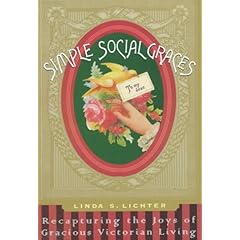 I've mentioned before that I'm very much a girly-girl, I love dressing up, and most of all I enjoy being feminine. I've always been very interested in gender roles, and in how our society has changed its views about gender roles (for better or for worse - probably some of both!) For my last assignment in my Senior Seminar class at college, I chose to write about the drastic change in fashion from the late Victorians to the Flappers of the 1920s, and what this outward change signified in terms of inner thoughts about gender roles. It seemed to me that while so-called feminists were claiming to want to fight for women and "free" them from the shackles of patriarchy and oppression, they went about it quite wrong. What they did was try to usurp men's roles, and try to turn themselves into men, and by doing so they actually diminished the value of women and femininity. I focused on fashion as the outward expression of this desire to become more man-like.
 Up until then, in all ages, female fashion was about emphasizing the uniquely female shape. In some ages it was popular to look nearly pregnant (with empire waists and such), in some ages it was popular to emphasize the hips (think 1700s full skirts with hoops protruding over the hips), in some ages it was popular to emphasize the derriere, with a bustle in the back. But it wasn't until the 20s that women started trying to de-emphasize their womanly figure. Hair was chopped off, breasts were bound tightly to appear flat-chested, dresses were shapeless, and big baggy suit-type dresses became popular. Behavior also changed, woman took up publicly drinking (and more importantly getting drunk) and smoking profusely to keep up with the men, and they also started trying to keep up with them in their number of casual sexual encounters. These issues and many more were the topic of my paper, Forsaking Femininity, and it remains a great interest to me. My curiosity was piqued, then, when someone from the ex-CoC board recommended a book about the Victorians and what they had that we have lost, called Simple Social Graces.
Much of this book clarifies some myths that we have about the Victorians that arose largely because of disdain for them, and out of attempts to promote modern ideas about sexuality and more. The author, Linda S. Lichter, explains well how the Victorians were not prudes who all thought sex was dirty and at best a duty, in fact they had such a high regard for it that they kept it where it should be - between husband and wife. I often wondered, as I studied Victorian literature, just how we got the concept that these people were stiff, cold, unfeeling prudes, because the literature I read swelled with beautiful descriptions of transcendental love, and of deep, yet controlled, passion. The "subtle sensuality" is more romantic than any smut widely seen on TV soap operas today. And isn't it the Victorian elaborate cards and meaningful flowers we think of when Valentine's Day comes around? They were certainly not lacking in love just because they thought it proper to control lust.
I've always seen a deep respect and consideration in the detailed traditions of the Victorians, especially in their focus on proper etiquette and treatment of people. Those who cry that such customs are "empty" and "superficial" tend to remind me of those who say the same about Catholic practices. But having come to believe in the truth of the phrase, lex orandi, lex credendi, I tend to think a proper translation applied to the Victorians would be, how we behave is how we believe. When you learn to treat everyone with consideration and respect because of customs and etiquette, it tends to spill over into your actual thought process.
 Lichter also explains how much of the etiquette protected women, and was actually very pro-woman, and allowed the woman to often be in charge of the situation. For instance, a man was expected to properly tip his hat or bow when passing a woman he knew on the street, and she was expected to show appreciation, but the man was not to "take advantage" of her polite return gesture by pushing more acquaintance, unless she invited it. It was her choice. Such universal rules helped to level the playing field, to allow everyone to be respectful and be respected.
Another topic Lichter talks about is the home, and how it has changed from the Victorian notion of the heart of the family, and a sanctuary to a mere building where people cohabitate. I couldn't help being reminded of the Catholic notion of the Domestic Church as she explained the Victorian views of home, a place where the smallest chore becomes an act of love and sacrifice for your family.
One thing I would have liked to see more of, which wasn't mentioned a whole lot was the effects of artificial birth control on our attitudes towards sex. There are some beautiful chapters about marriage and sex and how it has been cheapened by gross publicity and blatant vulgarity, which I think would have been made even better with a look at how significant a role artificial birth control played in that. She does mention in passing the Victorian view that contraceptives carried with them the danger of making women into a mere play-thing, and that men who practiced periodic abstinence for the sake of their wives' health epitomized self-sacrifice and proved their love (NFP anyone?), but that's about as far as it goes. The wisdom of the Church's teaching on contraception was a constant glaring factor for me as I read these chapters, though.
Simple Social Graces presents a stunning juxtaposition of just how far we have come in destroying respect for our fellow human beings, and especially women, even while modern feminists attempted to do the opposite. The small, simple things that were done revealed an underlying sense of self-sacrifice, and the focus was on humility rather than pride as it often is today.
There were a few things that I disagreed with in the book. I think it's possible that the often-perfect picture painted of the Victorians may be just a little too perfect. I also question the several unsubstantiated references to America being, hands down, the best and most forward-thinking country of the age. Prohibition is often mentioned in an apparently favorable light, which, in my mind, blames an object rather than calling on the necessary self-control touted throughout the rest of the book. I also think many of the character traits that were described as Victorian were not exclusively or originally Victorian, though they may have been the last group to embody them as a whole.
But on the whole, I thoroughly enjoyed Simple Social Graces. I came away with the overall sense that because people found high ideals to be hard to attain, they ended up lowering the ideals to the lowest common denominator. Lichter makes no secret about the fact that in the Victorian age (and before) women were looked to as the keepers of societal virtue, they set the standard and men were expected to meet it. When women began to lower their expectations, all of society suffered the consequences. Certainly in our age this idea sounds extremely sexist, but whether it's politically correct or not, I do believe it's true.
Subscribe to:
Posts (Atom)