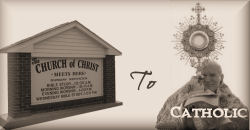
Sometimes, when discussing with people, I see some really great questions asked. The problem, though, is that often the person asking the question has already ruled out one or some of the answers, and sometimes they do this without even realizing it.
Among the flurry of recent Catholic related threads on the Preacher's Files, there was one question that made me want to shout for joy and pull my hair out at the same time. The question was a good one, but the refusal to acknowledge the most obvious answer was, to say the least, infuriating. The question was this:
IF what Adam is saying is based on actual fact about the Catholic organization representing God's ultimate intentions to the rest of the world AFTER the perversion by certain un-named individuals from an earlier time, then why didn't the Catholics re-write the Bible to coincide with their teachings and beliefs? They, the Catholic hiearchy dominated the world for over a thousand years during the Dark Ages in which they wouldn't let anyone but Catholic priests read and understand the Bible because they kept it written and taught in the ancient language of Latin.
This thousand year period would have been the perfect time frame to have re-written God's Word and thus appear to the world as consistent with God. They could have written in whole chapters (indeed whole books) illustrating indulgencies, priests with robes, special collars and forbiding them to marry, instrumental music and all the other major differences with their "style of Christianity" and true Christianity as God describes it in His Word.
This statement is so full of false assumptions and misconceptions that it makes my head spin. But the thing that stuck out most to me was the part in bold (emphasis mine). This is a very good question! Why didn't they rewrite the Bible? What is the most obvious answer??? Because there was no need to, because nothing in the Bible is contrary to Catholic teaching! It's amazing to me that this idea is SO FOREIGN to the person who asked the question, that he doesn't even take time to consider the possibility, and in fact it seems even expects Catholics themselves to agree that Catholic teaching is contrary to the scriptures!
But see, in attempts to show that they have misconceptions about Catholic teaching, any use of the catechism or other non-biblical text is shot down as "teaching of men." Remember, at this point no one (on the Catholic side of things) is trying to prove anyone right or wrong, we're simply trying to show that Catholics do not teach what they say Catholics teach.
Now, what if I use their logic and say, "Show me in the Bible where it says Catholics teach XYZ?" If anyone were nonsensical enough to even take up this challenge, they might provide the many typical scriptures used such as, "Call no man father" and the whole "doctrine of demons" stuff and the verses about if anyone else teaches another gospel they are false prophets, etc. I would ask, "Yes, I see those verses and I agree with them, but where does it say anything about Catholics teaching those things?" They might try to argue that it's obvious it's talking about Catholics, because the Catholic Church teaches them. If I ask where does it say that the Catholic Church teaches them, I would probably get redirected back to the same verses. And this, my friends, is what we call circular reasoning.
If, however, someone was a bit more aloof, and actually attempted to use the catechism or other document to show where Catholics teach XYZ, it would be a complete double standard to disallow a Catholic to use the same catechism or document to show him where Catholics don't teach XYZ. And yet, this happens all the time. In fact, there's a good example of a similar double standard in that very thread.
The poster mentions that they are using an extra-biblical text in bible class, and someone (a non-CoC member, as far as I can tell) asks him why not just use the Bible, since non-CoC members are told over and over again that nothing but the bible is useful or necessary.
I see no problem in supplementing our Bible study with such books as long as they don't add anything or take away anything but present God's Word in an organized manner and draw solid, Biblically based conclusions.
Hmm...seems to me that if a Catholic (or other kind of Christian) ever dares to use a text besides the bible (which also backs the things up it says with scripture and comes to biblically based conclusions, for instance the catechism), he is told that anything other than the bible is adding to God's Word. So...I guess that only applies to non-CoC members?
Usually the biggest benefit I see from studying such books is that they sometimes help "fleshing out" the details in the background or history behind some of the scenes and/or the decisions made in the Bible.
And again, if a Catholic appeals to history he is often told the only history he needs is in the bible, and it doesn't matter what history says or what the background was if it's not in the Bible. But again, I guess this only applies to non-CoC members.
The sad part is, most of the time CoC members don't even realize the circular arguments they are making and the double standards they hold. They are caught in a vicious circle inside their heads, unable to break free unless they commit the horrible sin of actually considering someone else's viewpoint. And this is why it is so hard to discuss with them, because in their world, showing respect and consideration for another viewpoint is nearly as bad as agreeing with it.
Thursday, February 08, 2007

Wednesday, February 07, 2007
Actions and Intentions
When I was in the CoC, there was a big disconnect with reality regarding intentions, especially regarding how we can know whether they are good or bad. In fact, intentions weren't talked about a whole lot, it wasn't often acknowledged that there was a difference between a bad action and a bad intention. This disconnect with reality often caused us to judge intentions unfairly, assuming that a bad action automatically indicated a bad intention. The focus was always on the outside, and rarely on the inside.
An obvious example of this kind of thinking is apparent on a few recent threads on the Preacher's Files. Specifically in this thread about Mary, and this thread about priestly robes and garments.
In the first thread, when talking about prayers and the usual "vain repition" verse, it does not even occur to the participating CoC members to acknowledge the difference between repitition, and vain repitition. They assume that all repitition must necessarily be vain. Because of this, they automatically judge anyone who participates in any kind of repetitive prayer as praying in vain.
Another example in the same thread is the use of statues. Again, a statue may certainly be used in an idolatrous way, by bowing down to it, believing the statue itself is somehow a deity higher than God. This is what God condemns. But the fact that someone may have a statue in front of them while they pray does not necessarily mean that they are treating the statue itself as a deity, as an idol. Anyone who recognizes the intention as distinct from the action can see this easily. But if someone has been taught that the two are inextricably entertwined, it is much harder for them to give someone the benefit of the doubt, and assume good intentions. No matter how much I may personally try to convince them that I do not think the statue itself is higher than God, they will discount my words because they cannot separate an action from an intention.
In the second thread, there are several expressions of incredulity at the idea that a priest wearing robes could be for any other reason than to puff himself up, show that he is more holy, etc. Again, this shows a failure to separate actions from intentions. I wasn't even asking that they agree that robes are ok, only trying to explain how wearing robes doesn't necessarily mean someone is trying to draw attention to himself.
This unwillingness to separate actions from intentions is a dangerous thing, because it leads to the idea that we can always judge people's intentions strictly by their actions. This leads to the judgemental attitude that so many who leave the CoC have been hurt by. It also leads to a scary understanding of a God who does not distinguish between actions and intentions, so that people are left to fearfully hope they have not unintentionally sinned without realizing it. It also leads to the idea that as long as our actions are ok, as long as we are keeping up appearances, it must necessarily follow that our intentions, our heart, needs no work, which leads to more pride. It's a sad, downward spiral that many well-meaning CoC members don't even realize is happening. But I always hold out hope that they may come to see the difference between actions and intentions, and to see the importance of acknowledging that difference. This realization is what first led me to where I am today.
Absurdity
Well folks, THIS is the resulting absurdity when people don't take the time to understand the difference between something being "ordered" towards procreation, and actually procreating.
OLYMPIA, Wash. - An initiative filed by proponents of same-sex marriage would require heterosexual couples to have kids within three years or else have their marriage annulled.
*Eyeroll*
OLYMPIA, Wash. - An initiative filed by proponents of same-sex marriage would require heterosexual couples to have kids within three years or else have their marriage annulled.
*Eyeroll*
Monday, February 05, 2007
How Very Sad...
This is what happens when the culture of death is so prevalent that you can get abortion pills over the counter.
GOTHENBURG, Sweden, Feb. 5 (UPI) -- A 26-year-old man in Sweden will face assault charges and abortion law violations after he allegedly slipped his pregnant girlfriend abortion pills.
How appropriate that St. Catherine of Sweden is the patron saint against abortion. St. Catherine, pray for us. Holy Mother, pray for us.
Thursday, February 01, 2007
For Music Lovers
This is really funny, especially for any musicians (cellists, bassoonists, etc) who are used to getting stuck with the repetitive background parts!
Subscribe to:
Posts (Atom)